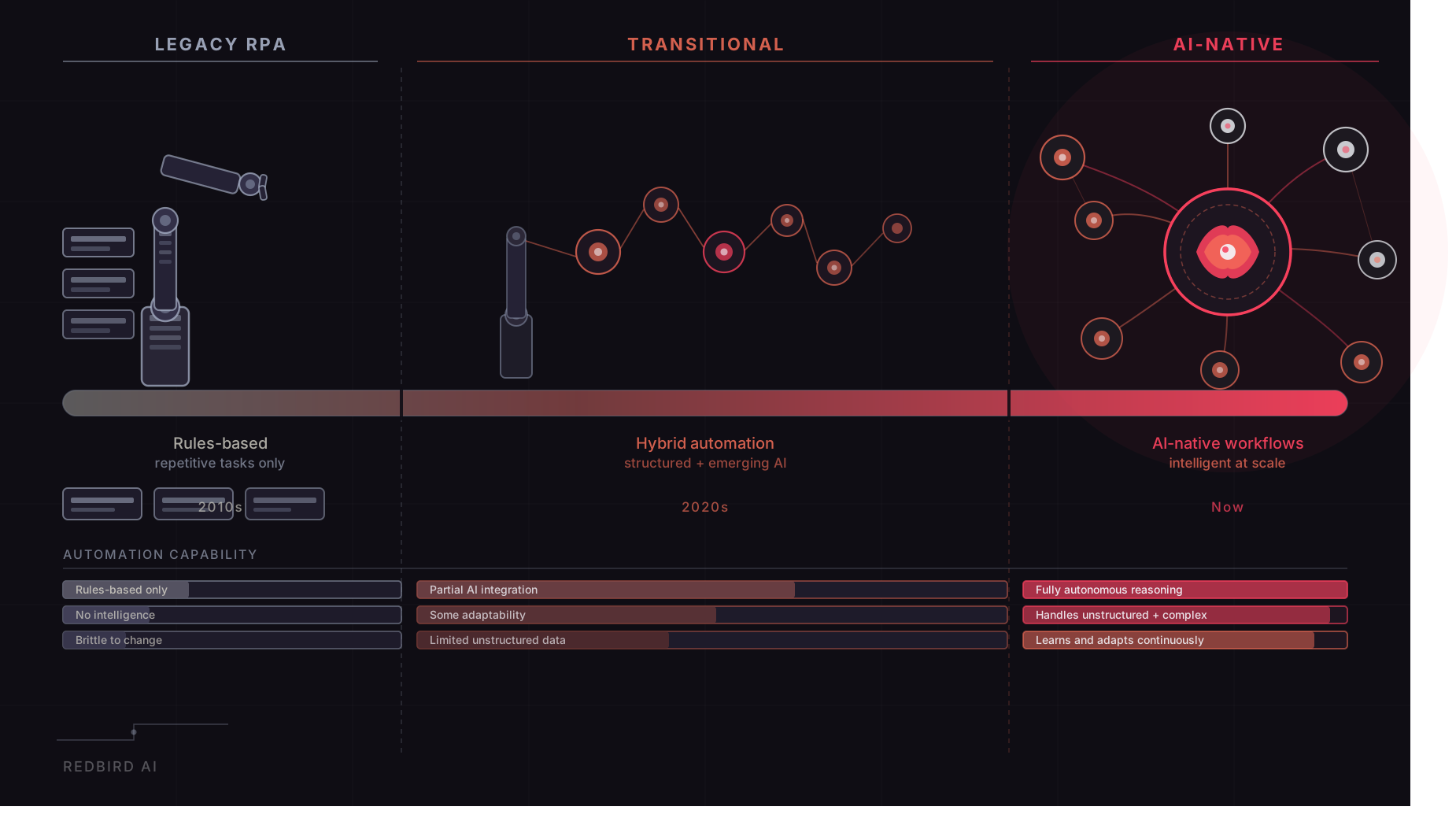
Enterprise automation is entering its second decade, and the conversation has shifted from tactical efficiency to strategic architecture. The first wave of robotic process automation focused on mimicking human clicks and keystrokes across enterprise systems. That wave delivered measurable ROI. Finance teams reduced manual entry, operations teams automated reconciliations, and IT departments offloaded repetitive tasks.
Today, executives and CTOs are asking a more forward-looking question: not simply which RPA platform works, but which RPA platform will remain resilient, scalable, and intelligent as AI becomes embedded in every workflow.
Organizations searching for a UiPath competitor, an Automation Anywhere competitor, or a Power Automate competitor are often driven by similar pressures: bots that require updates when interfaces change, automation programs that demand dedicated maintenance teams, AI capabilities that enhance workflows but do not fundamentally redefine them, and an increasing need for AI for web scraping and adaptive automation in dynamic web environments.
To evaluate the next generation properly, it is important to understand how the current leaders operate and where their strengths and architectural tradeoffs lie.
The Enterprise RPA Landscape
Traditional RPA platforms were designed around deterministic logic. Developers configure bots to interact with applications using selectors, screen elements, and structured rules. When processes are stable and well defined, this model performs extremely well. It can reduce headcount pressure, accelerate turnaround times, and standardize operations across departments.
As enterprises digitize more workflows and depend heavily on browser-based systems, complexity increases. Interfaces evolve. Page structures shift. Exceptions multiply. Automation that initially appears straightforward can expand into an operational discipline requiring governance, monitoring, and continuous updates.
The question is no longer whether RPA works. It does. The question is how traditional RPA architectures evolve as AI becomes central to enterprise automation strategy — and whether rule-based automation models can adapt quickly enough in dynamic digital environments.
UiPath
UiPath is widely recognized as a category leader in enterprise RPA. It built its reputation through a robust development studio, strong orchestration capabilities, and a large global ecosystem of partners and practitioners. For enterprises building centralized automation programs, UiPath is often a default consideration.
Pros
UiPath provides enterprise-grade governance and lifecycle management. Its orchestration tools enable large bot deployments with monitoring and compliance controls. The platform can handle complex workflows across legacy systems and modern web applications, and its training ecosystem has helped organizations professionalize RPA as a discipline. UiPath has also invested significantly in AI-driven capabilities such as document understanding, process mining, and generative AI enhancements.
Cons
Organizations evaluating a UiPath competitor sometimes cite maintenance overhead in UI-driven automations, particularly in rapidly evolving web environments. Automation execution remains grounded in predefined workflows and selector-driven logic, which can require updates as underlying interfaces change. Scaling beyond pilot use cases frequently demands dedicated development resources and ongoing operational support. While AI capabilities are integrated into the platform, core automation execution continues to rely heavily on structured, rule-based processes.
For enterprises seeking highly adaptive AI for web scraping and dynamic web interaction, the question becomes how much configuration and tuning is required over time.
Automation Anywhere
Automation Anywhere competes directly in the enterprise RPA space and has positioned itself strongly around cloud deployment and intelligent automation capabilities.
Pros
Automation Anywhere offers a centralized Control Room for managing bots at scale and supports cloud-native deployment models through Automation 360. It incorporates intelligent document processing features that extend beyond simple screen automation into semi-structured data extraction. The platform has invested in AI-driven automation and generative AI integrations, and for organizations modernizing infrastructure, its cloud orientation can be appealing.
Cons
Enterprises exploring an Automation Anywhere competitor sometimes encounter implementation complexity as automation footprints expand across departments and systems. Like other traditional RPA platforms, core workflows are primarily executed through deterministic selectors and predefined logic. As environments evolve, updates and governance oversight are required. Intelligent components augment these workflows, but the execution model remains largely structured and rule-driven.
Over time, governance and maintenance considerations can influence the long-term ROI of large-scale automation programs.
Microsoft Power Automate
Power Automate extends Microsoft’s broader ecosystem with both cloud-based workflow automation and desktop RPA capabilities. For enterprises standardized on Microsoft 365 and Azure, it provides a convenient entry point into automation.
Pros
Deep integration with Microsoft products is a clear advantage. Licensing can align with existing enterprise agreements, and business users can build relatively simple workflows without extensive engineering support. Desktop RPA enables automation of legacy applications where APIs are unavailable. Microsoft continues to expand AI capabilities across its ecosystem, including Copilot and Azure AI services.
Cons
Organizations seeking a Power Automate competitor frequently point to ecosystem constraints in heterogeneous IT environments. Complex cross-platform workflows may require additional configuration and governance. As use cases grow more sophisticated, technical oversight often increases. While AI capabilities are expanding rapidly within Microsoft’s stack, orchestration and automation logic remain closely tied to predefined workflows within the broader Microsoft ecosystem.
For enterprises operating across diverse systems and third-party platforms, architectural flexibility becomes an important evaluation criterion.
Redbird: AI-Native RPA for a New Era
The common thread across traditional RPA platforms is structured, rule-based automation. Bots are designed, configured, and maintained around predefined workflows. When systems are stable, this approach delivers value. When systems evolve, maintenance follows.
Redbird was architected with a different philosophy. Instead of centering automation around rigid scripts, Redbird leverages a Chrome extension and AI to generate adaptive RPA steps informed by semantic understanding of page structure and task intent. Rather than relying exclusively on static selectors, automation incorporates contextual interpretation of web environments. This architecture is designed to reduce breakage in dynamic web workflows and strengthen AI-driven web scraping use cases where page variability is common.
Beyond web interaction, Redbird extends automation across the full data lifecycle, addressing the reality that business teams in marketing, research, and finance often rely on manual, error-prone workflows to collect, merge, and transform data. Redbird unifies ingestion, transformation, analytics, and output generation within a single agentic platform where AI agents handle data collection, harmonization, forecasting, anomaly detection, and final report production.
Natural language requests are translated into deterministic, auditable workflows through a robust orchestration layer in which large language models play a controlled and structured role. By consolidating what traditionally required multiple disconnected tools into a single environment, teams can move seamlessly from raw data to production-ready PowerPoint decks, Excel files, and reports automatically — shifting from task automation to true outcome automation.
This architectural distinction is central. Redbird positions AI as a foundational component of workflow construction and execution rather than as a standalone enhancement layer. Orchestration ensures reliability and auditability, while agentic automation enables systems to adapt to changing conditions without constant manual reconfiguration.
Choosing the Right RPA Strategy
For executives and CTOs evaluating a UiPath competitor, an Automation Anywhere competitor, or a Power Automate competitor, the decision extends beyond feature comparisons and licensing models. The more important question is architectural direction.
Does the platform primarily execute predefined selector-based workflows, or can it interpret and adapt to dynamic web environments?
Is AI embedded deeply into how workflows are constructed and orchestrated, or primarily integrated as an enhancement to structured automation?
Can the solution automate not just discrete tasks, but the journey from data collection through analytics to final executive deliverables?
As automation scales, does the operating model require increasing maintenance overhead, or is the architecture designed to reduce brittleness over time?
The next phase of RPA is not about faster bots. It is about AI-native automation that understands context, adapts to change, and delivers business-ready outcomes end to end. For organizations operating in increasingly complex digital ecosystems, that shift represents not just incremental efficiency, but a structural competitive advantage.