If you've spent any time evaluating data pipeline tools recently, you already know how overwhelming the landscape has become. There are dozens of platforms competing for the same budget line, each promising to eliminate manual work and unlock the value of your data. The challenge isn't finding options, it's understanding what each tool actually does, where it falls short, and whether it was designed for a team like yours. This guide is written specifically for business teams in marketing, finance, research, and analytics who need fast, reliable access to data and finished deliverables, but don't have a dedicated data engineering team sitting beside them to build and maintain complex infrastructure.
To be clear about scope: ETL (Extract, Transform, Load) and data pipeline tools are not all the same thing. Some tools focus exclusively on moving data from point A to point B. Others handle transformation logic but require you to already have clean data in a warehouse. Still others are orchestration frameworks built by engineers, for engineers. Understanding those distinctions is the most important thing you can do before evaluating any vendor, because the wrong category of tool will feel like a mismatch from day one regardless of how well-regarded it is.
The Landscape: What Kind of Tool Are You Actually Looking For?
Most data pipeline tools fall into one of three categories, and recognizing which category a tool belongs to will save you significant time during evaluation.
The first category is connector and ingestion tools. These platforms are primarily focused on extracting data from source systems - your CRM, your ad platforms, your databases - and loading it into a destination like a cloud data warehouse. They solve a real and important problem, but they stop at the warehouse door. Once the data lands, you still need to transform it, analyze it, and produce something a business stakeholder can act on.
The second category is transformation and modeling tools. These operate inside your data warehouse and allow analytics engineers to define how raw data should be structured, cleaned, and joined. They require SQL proficiency at minimum and are designed to be maintained by technical practitioners. They are enormously powerful in the right environment, but they assume the data is already loaded and that someone with engineering skills is available to write and manage the logic.
The third category is orchestration frameworks. These are workflow schedulers and pipeline managers that coordinate when and how tasks run across your data stack. They are the connective tissue of a mature data platform and are generally considered infrastructure-level tooling, meaning they are built, deployed, and managed by data engineers, not business analysts. Understanding where each of the tools below sits within these categories will help you evaluate them honestly against your team's actual needs.
Fivetran
Fivetran is one of the most well-known and widely adopted data integration platforms on the market, and for good reason. It specializes in fully managed, automated connectors that replicate data from hundreds of source systems - SaaS applications, databases, file storage, ERPs - into your destination warehouse with minimal configuration. The product's core value proposition is reliability: Fivetran connectors are pre-built, maintained by the vendor, and designed to handle schema changes automatically, which eliminates a category of maintenance work that data teams historically spent significant time on.
For organizations with a data engineering team and an established warehouse like Snowflake, BigQuery, or Databricks, Fivetran is an excellent solution for the ingestion layer of a modern data stack. It integrates cleanly with transformation tools like dbt and fits naturally into a pipeline where an engineering team owns the end-to-end architecture. The managed connector model means that when a source API changes, Fivetran handles the update rather than your team.
Where Fivetran falls short is in what it doesn't do. It is strictly an ingestion and replication tool. It does not transform data, run analytics, or produce business deliverables. After data lands in your warehouse, the rest of the work - modeling, analysis, reporting - is still entirely on your team. For organizations with strong data engineering support, this is fine because those teams own the downstream layers. For business teams without that support, Fivetran solves one piece of the puzzle while leaving the harder, more time-consuming pieces untouched. Pricing is also a common friction point, as Fivetran's consumption-based model can become expensive as data volumes grow and costs can be difficult to predict.
Best for: Mid-to-large organizations with dedicated data engineering teams that need reliable, low-maintenance data ingestion into a cloud warehouse.
Airbyte
Airbyte is the open-source alternative to Fivetran and has built a large and active community since its launch. Like Fivetran, Airbyte is focused on data ingestion - moving data from sources to destinations via a library of connectors. The key differentiator is the open-source model: the connector library is community-maintained and rapidly expanding, the platform can be self-hosted, and the licensing cost is zero for teams willing to run their own infrastructure.
Airbyte Cloud is available for teams that want a managed experience closer to Fivetran, but the open-source self-hosted option is what drives most of the adoption in developer-heavy organizations. For technical teams that want full control over their pipeline infrastructure and are comfortable managing deployment, Airbyte offers a level of transparency and customizability that Fivetran doesn't. Custom connectors can be built in Python, which matters when you're working with proprietary or less common data sources.
The tradeoffs are real, however. Self-hosting Airbyte means your team owns the infrastructure, monitoring, and maintenance, which reintroduces the engineering overhead that managed tools like Fivetran are designed to eliminate. Community-maintained connectors vary in quality and reliability, and for production workflows where data accuracy is critical, that inconsistency can be a problem. Like Fivetran, Airbyte is also purely an ingestion layer. It does not transform or analyze data, and it produces no business output on its own. Teams still need a full downstream stack to get from raw data to insight.
Best for: Engineering-forward teams and startups that want open-source flexibility and control over their ingestion infrastructure, and have the technical capacity to manage it.
dbt (data build tool)
dbt has become one of the most influential tools in the modern data stack and has fundamentally changed how analytics engineers think about data transformation. It operates entirely inside your data warehouse and allows practitioners to define transformation logic in SQL, organize it into modular models, test data quality, and document lineage - all using software engineering best practices like version control. For organizations building a serious analytics engineering function, dbt is close to indispensable.
The quality of what dbt enables is genuinely impressive. When a skilled analytics engineer uses dbt well, the result is a clean, well-tested, well-documented transformation layer that becomes a reliable foundation for reporting and analysis across the organization. dbt Cloud adds scheduling, observability, and collaboration features that make it production-ready for enterprise environments.
That said, dbt is a tool built for analytics engineers, not business analysts. It requires SQL proficiency, an understanding of data modeling concepts, and familiarity with development workflows. It also assumes that data is already in your warehouse - dbt does not handle ingestion. And critically, dbt produces transformed tables and views inside your warehouse; it does not generate reports, presentations, or business deliverables. An analyst using dbt still needs to export data into Excel or connect a BI tool to actually produce something a stakeholder can read. For teams without a dedicated analytics engineer, dbt adds complexity rather than reducing it.
Best for: Organizations with analytics engineers or data teams that want to build a rigorous, well-governed transformation layer on top of an existing warehouse.
Stitch
Stitch, now part of Talend, occupies a similar space to Fivetran but targets a slightly different buyer. It is a cloud-native data integration platform focused on simplicity and affordability, designed to get data from source systems into a warehouse quickly without requiring deep technical expertise. The setup experience is intentionally streamlined, and the pricing model has historically been more accessible for smaller teams and companies that aren't ready to commit to Fivetran's cost structure.
Stitch supports a solid library of integrations and works well for teams that need reliable data replication without a lot of customization. For straightforward use cases - syncing Salesforce records into Snowflake, pulling Google Ads data into BigQuery - it gets the job done with minimal friction. It is a reasonable choice for early-stage data programs where the priority is getting data centralized quickly before investing in a more sophisticated stack.
The limitations mirror those of other connector-focused tools. Stitch is an ingestion platform, not an analytics platform. It doesn't transform data beyond basic column selection, it doesn't run analysis, and it doesn't produce outputs. There are also constraints on the complexity of transformations and custom connector support compared to Fivetran, which matters as use cases become more demanding. Teams that start with Stitch often find they outgrow it as data volumes and workflow complexity increase.
Best for: Small-to-mid-size teams looking for an affordable, easy-to-configure ingestion solution for common SaaS and database sources.
Apache Airflow
Apache Airflow is the most widely deployed workflow orchestration platform in the data industry and has been a foundational piece of enterprise data infrastructure for years. Originally developed at Airbnb, Airflow allows engineers to define data pipelines as code using Python, schedule and monitor workflows, manage dependencies between tasks, and build complex multi-step data processes that can span many systems. It is powerful, flexible, and backed by a massive open-source community.
For mature data organizations with dedicated platform or data engineering teams, Airflow is a serious and proven tool. It integrates with virtually everything, scales to handle complex enterprise workloads, and has a rich ecosystem of plugins and providers. Managed versions like Google Cloud Composer and Astronomer reduce some of the operational overhead associated with self-hosting, though meaningful engineering effort is still required to design and maintain pipelines.
Airflow is infrastructure, and it was built to be managed by infrastructure practitioners. Writing Airflow DAGs requires Python expertise, an understanding of distributed systems concepts, and familiarity with DevOps practices. For business teams without that kind of support, Airflow is essentially inaccessible - not because it's poorly designed, but because it was never intended for non-technical users. It orchestrates workflows; it does not simplify them. It also produces no analytical outputs on its own - its job is to coordinate when other tools run, not to generate reports or insights.
Best for: Enterprise data engineering teams that need flexible, code-driven workflow orchestration across a complex data stack.
Dagster
Dagster is a more modern orchestration platform that has gained significant momentum as an alternative to Airflow, particularly among teams that want to treat data assets - not just tasks - as first-class objects in their pipelines. Where Airflow is organized around task graphs, Dagster is organized around data assets, which makes it easier to understand pipeline dependencies, track data lineage, and build observable, testable workflows. The developer experience is notably cleaner than Airflow, and Dagster Cloud offers a managed deployment option that reduces operational burden.
For data engineering teams building greenfield data platforms or looking to modernize away from Airflow, Dagster is a compelling choice. The asset-centric model maps naturally to how analytics teams think about data, and the built-in observability features make it easier to understand what's happening inside complex pipelines. Integration with dbt is tight, which matters for teams running dbt at the core of their transformation layer.
Like Airflow, however, Dagster is an orchestration tool for engineers. It requires Python, a solid grasp of data engineering concepts, and ongoing maintenance as pipelines evolve. It is not a self-service platform for business analysts, and it produces no business outputs independently. Teams evaluating Dagster should be honest about whether they have the engineering capacity to build and maintain a Dagster-based platform, because the tool's value is proportional to the effort invested in it.
Best for: Data engineering teams building modern, asset-centric data platforms who want better observability and developer experience than Airflow provides.
What These Tools Have in Common and Where the Gap Is
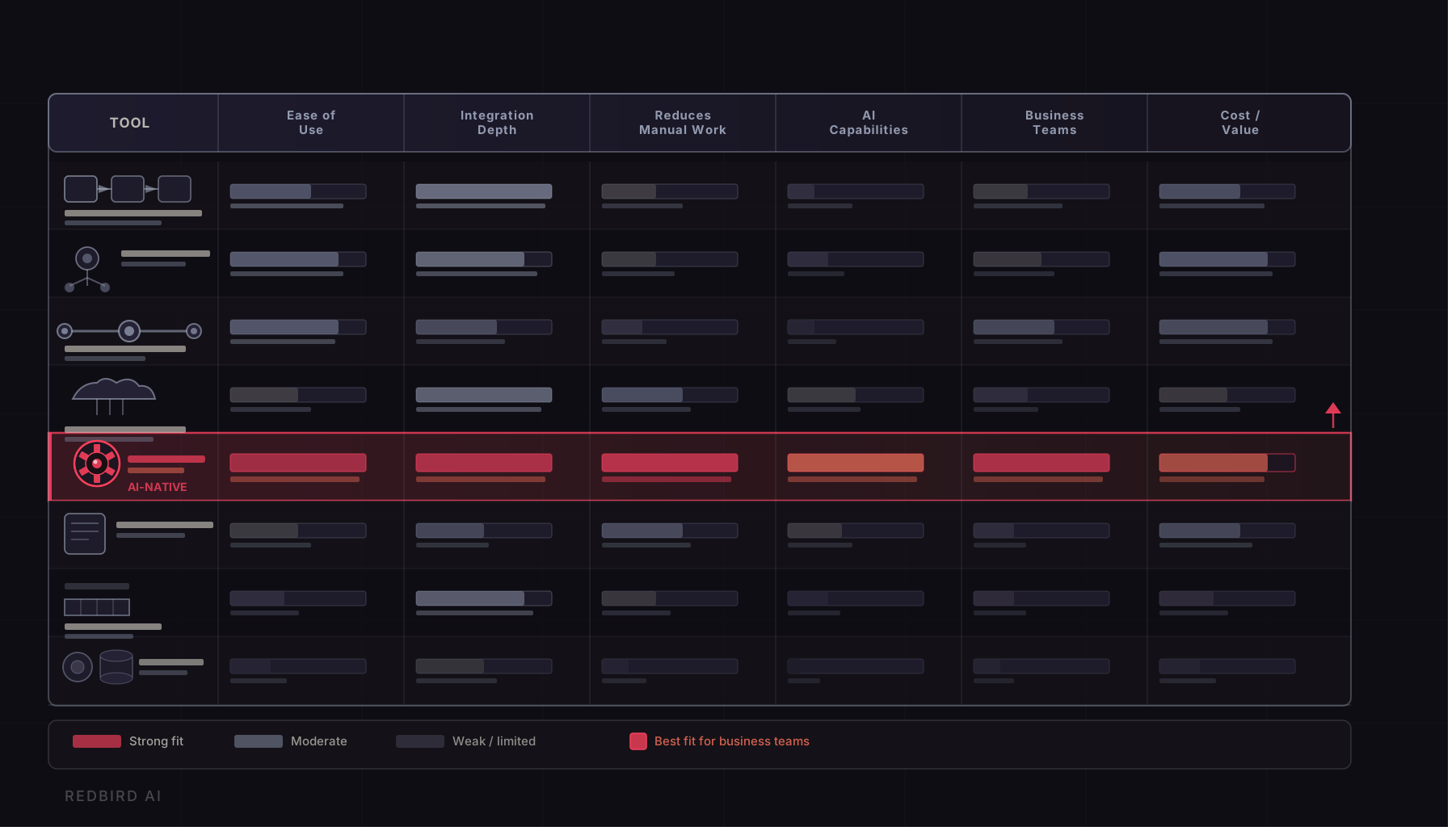
Reading through the tools above, a clear pattern emerges. Fivetran, Airbyte, and Stitch solve the ingestion problem. dbt solves the transformation problem. Airflow and Dagster solve the orchestration problem. Each tool does its job well within its defined scope. But if your goal is to go from raw data scattered across source systems to a finished, accurate, presentation-ready deliverable - without a team of data engineers stitching these layers together - none of these tools gets you there on its own.
For teams in marketing, finance, research, and operations that depend on fast, accurate reporting to support client deliverables, performance tracking, and business decisions, the traditional data stack creates a real bottleneck. Building and maintaining a pipeline that spans ingestion, transformation, orchestration, and output generation requires dedicated engineering resources that most business teams simply don't have. The result is a familiar situation: analysts spending the majority of their time on manual data collection, spreadsheet manipulation, and report formatting rather than on the analysis and insights that actually drive decisions. This is the gap that a newer category of tools is designed to address - platforms that handle the full data lifecycle end-to-end, from connecting to source systems all the way through to producing polished, business-ready outputs, without requiring a data engineering function to operate.
Redbird: A Full-Lifecycle Alternative Built for Business Teams
Redbird approaches the data pipeline problem from a fundamentally different angle than the tools described above. Rather than solving one layer of the data stack in isolation, Redbird automates the entire workflow end-to-end: data collection, transformation and harmonization, analytics and data science, and output generation - all through a conversational, natural language interface that non-technical users can operate without engineering support.
On the connectivity side, Redbird connects to virtually any data source, including raw files, cloud data warehouses like Snowflake and Databricks, and enterprise systems like SAP and Oracle. Where standard API connections aren't available, Redbird uses robotic process automation to extract data directly, which means the platform can reach sources that connector-focused tools often cannot. Once data is collected, Redbird's AI agents handle harmonization, custom calculations, anomaly detection, and data science workflows automatically - no SQL required, no transformation models to write and maintain.
What distinguishes Redbird most clearly from the tools in this guide is what it produces at the end of a workflow. Rather than depositing transformed data into a warehouse for downstream tools to consume, Redbird generates production-ready business deliverables: AI-generated PowerPoint presentations, Excel files, Word documents, and dashboards formatted to your organization's existing templates and standards. The entire process - from a user asking a question in natural language to receiving a finished, formatted report - runs autonomously through a multi-step agentic AI system designed for enterprise-grade accuracy.
This architecture matters for a specific kind of buyer. If you're a data team embedded in a business function without dedicated data engineering support, or if you're part of a larger organization where centralized data teams can't move fast enough to keep up with the reporting needs of individual business units, Redbird is designed precisely for that environment. The platform is also well-suited for consultancies and professional services firms that need to produce high-quality, consistent data deliverables for clients at scale. Rather than replacing a mature data stack, Redbird acts as a productivity layer on top of whatever infrastructure already exists, which means teams don't face the disruption of migrating away from tools they've already invested in.
The honest comparison to draw is not between Redbird and any single tool in this guide, but between Redbird and the entire combination of tools a business team would otherwise need to assemble: a connector for ingestion, dbt for transformation, Airflow for orchestration, and a BI tool or manual process for reporting. For teams with the engineering resources to build and maintain that stack, the traditional approach has real merit. For teams without those resources or for teams tired of watching analyst time disappear into manual reporting rather than actual analysis - Redbird represents a meaningfully different model.
How to Choose the Right Tool for Your Team
The right answer depends almost entirely on your team's technical capacity and what you need the tool to produce. If you have a dedicated data engineering team and your primary need is reliable data ingestion into an existing warehouse, Fivetran or Airbyte are strong choices depending on whether you prefer a fully managed experience or open-source flexibility. If transformation and data modeling are the core need and you have analytics engineers on staff, dbt is the category leader. If you're building enterprise-scale orchestration and have the engineering resources to operate it, Airflow and Dagster are both proven options with meaningfully different philosophies.
If, on the other hand, your team consists primarily of business analysts, the bottleneck is the time between raw data and finished deliverable, and engineering support is limited or unavailable, then the tools in this guide will collectively require more infrastructure investment than they eliminate. In that situation, evaluating a full-lifecycle platform like Redbird is worth your time before committing to a multi-tool stack that will require ongoing engineering maintenance to function. The most important question to ask any vendor is not "what can your tool do?" but "what does my team still have to do after your tool does its part?" For business teams that need to move fast, that second question changes the evaluation considerably.
Frequently Asked Questions
Do I need a data engineer to use ETL tools? For most of the tools in this guide - particularly dbt, Airflow, and Dagster - yes, in practice. While some tools like Fivetran and Stitch have relatively accessible interfaces, the downstream work of transforming, modeling, and reporting on ingested data typically requires SQL skills at minimum and data engineering expertise in more complex scenarios. If your team doesn't have that capacity, you'll want to evaluate tools designed specifically for non-technical or analyst-level users.
What's the difference between ETL and ELT? ETL (Extract, Transform, Load) refers to transforming data before it's loaded into a destination. ELT (Extract, Load, Transform) loads raw data first and transforms it inside the destination warehouse. Most modern cloud-native tools follow the ELT model because cloud warehouses like Snowflake and BigQuery are powerful enough to handle transformation at scale. The practical difference for most business teams is small - what matters more is whether transformation happens at all and who is responsible for it.
Is open-source ETL software worth it for business teams? It depends on your technical capacity. Open-source tools like Airbyte offer real flexibility and cost advantages, but they require your team to manage infrastructure, monitor reliability, and handle updates. For engineering teams, this trade-off often makes sense. For business teams without dedicated technical support, the ongoing maintenance overhead tends to outweigh the cost savings.
What if I need my data tools to produce reports and presentations, not just move data? Most traditional ETL and pipeline tools are not designed to produce business-facing outputs - that's typically handled by BI tools, spreadsheets, or manual reporting processes downstream. If your core need is going from raw data to a finished report or presentation, you'll want to evaluate platforms designed specifically for that full-lifecycle workflow rather than assembling multiple point solutions and hoping they work together smoothly.