AI has fundamentally changed how teams engage with data. Questions that once required a ticket can now be asked in natural language. Analyses that previously took hours of querying and formatting can be produced in seconds. Draft narratives, charts, and explanations materialize almost instantly. The experience feels like a dramatic step forward, and in many ways it is.
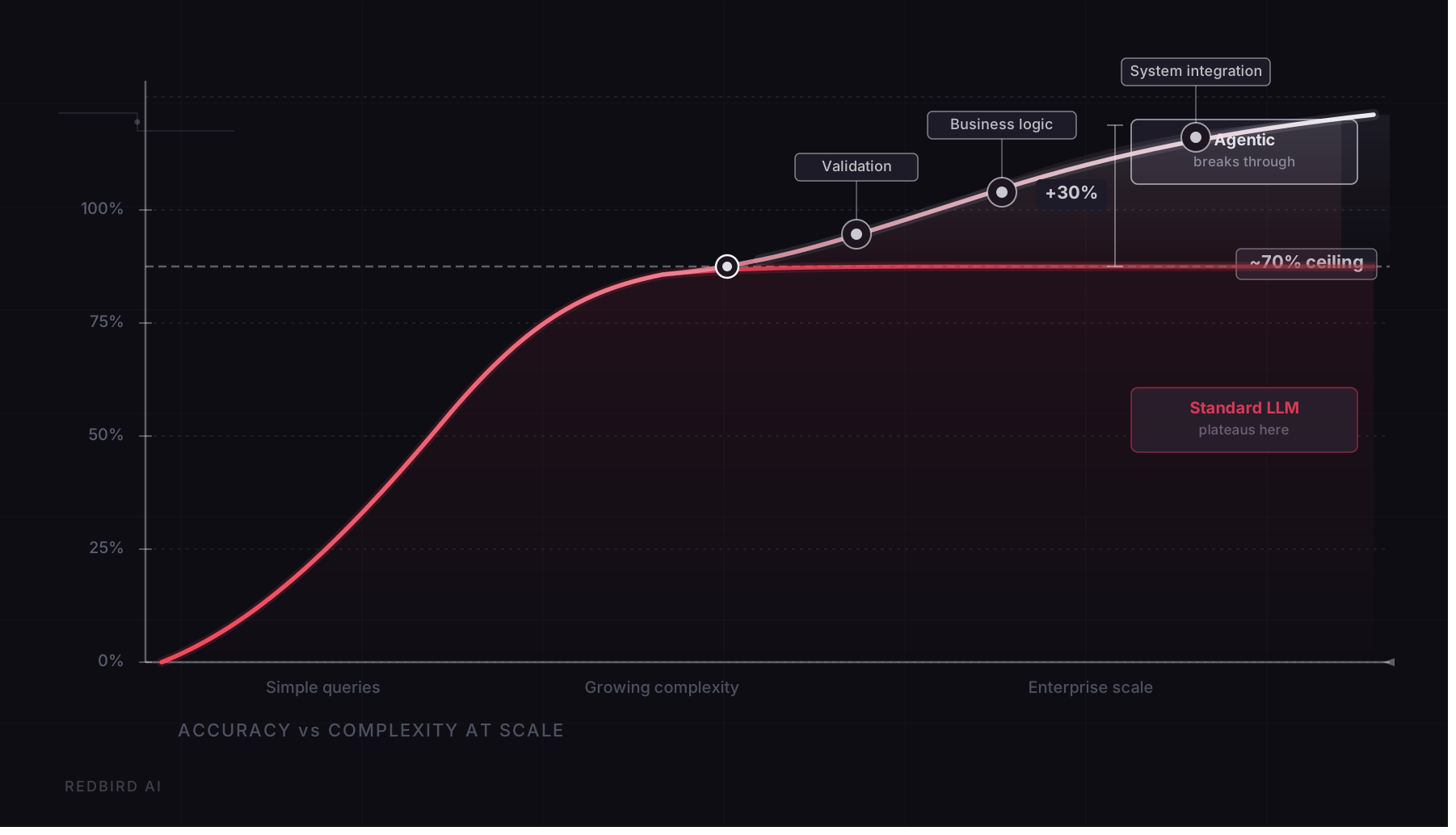
But when organizations attempt to push these systems beyond exploration and into the daily mechanics of operating the business, a consistent pattern appears. Performance rises quickly, enthusiasm follows, and then progress slows. Somewhere around 70 percent accuracy, improvement becomes incremental, confidence plateaus, and people quietly reinsert themselves into the workflow as the ultimate guarantors of correctness.
Executives often experience this moment as confusion. If the models are so capable, why can’t we close the final gap? Practitioners, on the other hand, tend to recognize it immediately. Practitioners, on the other hand, tend to recognize it immediately. They know exactly where things break, because they are the ones who have to fix the outputs before anything can move forward.
To understand why the plateau exists, we have to look beyond intelligence and examine execution.
Getting Close Is Easy. Being Correct Is Hard.
Modern models are exceptional at producing responses that look right. They understand the structure of language, the grammar of analytics, and the patterns that typically appear in business questions. When given partial context, they can infer intent, write plausible SQL, assemble a reasonable calculation, and wrap the result in a coherent explanation. That capability alone removes enormous friction from day-to-day work and explains why adoption has been so rapid.
However, plausibility is not the same as fidelity. In a production environment, answers must reconcile exactly with financial statements, match previously published numbers, respect approved definitions, and withstand scrutiny from multiple stakeholders who all carry institutional memory. A metric that is off by a few percentage points is not partially useful; it is unusable. A chart that applies the wrong filter is not a starting point; it is a liability.
The moment analytics leaves the realm of exploration and enters the domain of accountability, tolerance for approximation disappears. What felt magical at 70 percent suddenly feels fragile.
Real Analytics Work Is a Chain, Not a Prompt
One reason expectations collide with reality is that AI interactions are often framed as single exchanges: a request goes in, an answer comes out. Actual enterprise analytics rarely behaves that way. Producing a trustworthy output typically involves a sequence of dependent steps that span systems, teams, and definitions accumulated over years.
Data must be gathered from multiple sources, many of which were never designed to align. Schemas conflict. Field meanings drift. Business rules evolve quietly in spreadsheets or in someone’s head. After the data is assembled, calculations need to be applied in precisely the way finance or operations expects. Then the result has to be packaged into formats the organization uses to communicate, whether that is a board slide, a client report, or a planning model. Finally, everything must tie back to prior periods so no one is surprised.
None of this complexity is abstract. It is operational, and it is where reliability is won or lost. When AI produces an answer that is technically elegant but misaligned with even one link in that chain, humans step in to repair it. The workflow reverts to manual supervision, and the promised efficiency gains begin to erode.
Verification Quietly Eats the Savings
At this stage many teams discover something subtle but critical: if every output requires review, automation stops compounding. An analyst validating an AI-generated result must reconstruct the reasoning, inspect the joins, confirm the filters, and check that the numbers align with institutional standards. That cognitive effort often approaches the work required to build the analysis independently, particularly when stakes are high.
As a result, AI becomes a drafting partner rather than an execution engine. It accelerates the beginning of the process but does not remove the responsibility at the end. People remain accountable for correctness, so they behave rationally. They double-check. They maintain shadow calculations. They keep fallback workflows. Trust advances cautiously, if at all.
From a distance, it may appear that AI is embedded in the operation. Up close, humans are still carrying the risk.
The Gap Between Generation and Execution
Most current AI analytics products are built to generate artifacts: a query, a paragraph, a visualization. That is enormously valuable for learning and discovery, but production analytics depends on something different. It depends on execution that is repeatable, governed, and aligned with how the organization actually runs.
Execution means retrieving the correct inputs automatically, applying sanctioned logic, orchestrating tasks in the proper order, handling exceptions, and producing outputs in consistent formats every time. It means the process tomorrow behaves like the process today. Without those properties, scale is limited because every instance must be revalidated.
This is why systems that perform brilliantly in demonstrations can struggle inside weekly operating cadences. The difficulty is not producing an answer. The difficulty is guaranteeing it.
Why Better Models Alone Don’t Solve It
Model quality continues to improve at extraordinary speed. Reasoning becomes more sophisticated. Context windows grow. Error rates decline. These advances matter, and they will keep mattering.
Yet many of the barriers to trust inside enterprises are no longer primarily about cognition. They are about alignment. Organizations require shared definitions, lineage awareness, policy enforcement, memory of prior outputs, and the ability to audit how a result was produced. When those elements are missing, every request feels new, and humans must once again bridge the gap between what the AI produced and what the business will accept.
You can make the brain smarter, but if the surrounding system is unstructured, reliability will still depend on people.
Humans as the Default Control Plane
This is how the 70 percent plateau stabilizes. AI proposes; humans dispose. People route work, clarify intent, reconcile discrepancies, and ultimately convert drafts into deliverables that others can rely on. They become the connective tissue between otherwise disconnected steps.
It is expensive, and it constrains scale. Highly trained analysts spend time coordinating rather than interpreting. Turnaround times stretch. Variability creeps in. Most importantly, the organization continues to believe that final accountability resides with individuals rather than with infrastructure.
Until that changes, adoption will remain cautious.
Raising the Ceiling Requires Structural Change
Breaking through the plateau demands more than incremental model improvement. It requires systems that retain organizational context, enforce definitions automatically, and translate requests into structured sequences of deterministic actions. When that foundation exists, AI no longer has to infer what a metric might mean or where trusted data lives. It operates within boundaries that mirror how the company already governs itself.
Under those conditions, repeatability increases and variance declines. Humans remain essential, but they shift toward supervision, refinement, and exception handling instead of reconstruction. Confidence grows not because the machine feels magical, but because the process becomes predictable.
Trust, in other words, becomes architectural.
The Direction of Travel
Analytics has always evolved in stages. Tools enabled individuals to compute. Assistive systems helped them move faster. Agents are now emerging that can carry out sequences of work. The next logical step is execution environments where workflows run reliably with humans defining policy and oversight rather than performing assembly.
Each stage removes another layer of manual mediation. Each stage allows organizations to operate at higher tempo without proportionally increasing headcount.
And each stage makes it possible for conversations to move away from whether a number is correct and toward what action should follow.
Looking Beyond the Plateau
The widely discussed accuracy ceiling is not a permanent verdict on AI. It is a snapshot of how enterprise analytics is currently wired. As companies invest in capturing context, formalizing knowledge, and designing orchestration into their systems, the boundary between assistance and dependable execution will shift.
When that happens, analytics will begin to function less like a service request and more like infrastructure that continuously supports the business. Reliability will come from design rather than heroics. And the people who once spent their days validating outputs will be free to focus on judgment, prioritization, and strategy.
That is the real opportunity waiting on the other side of 70 percent.