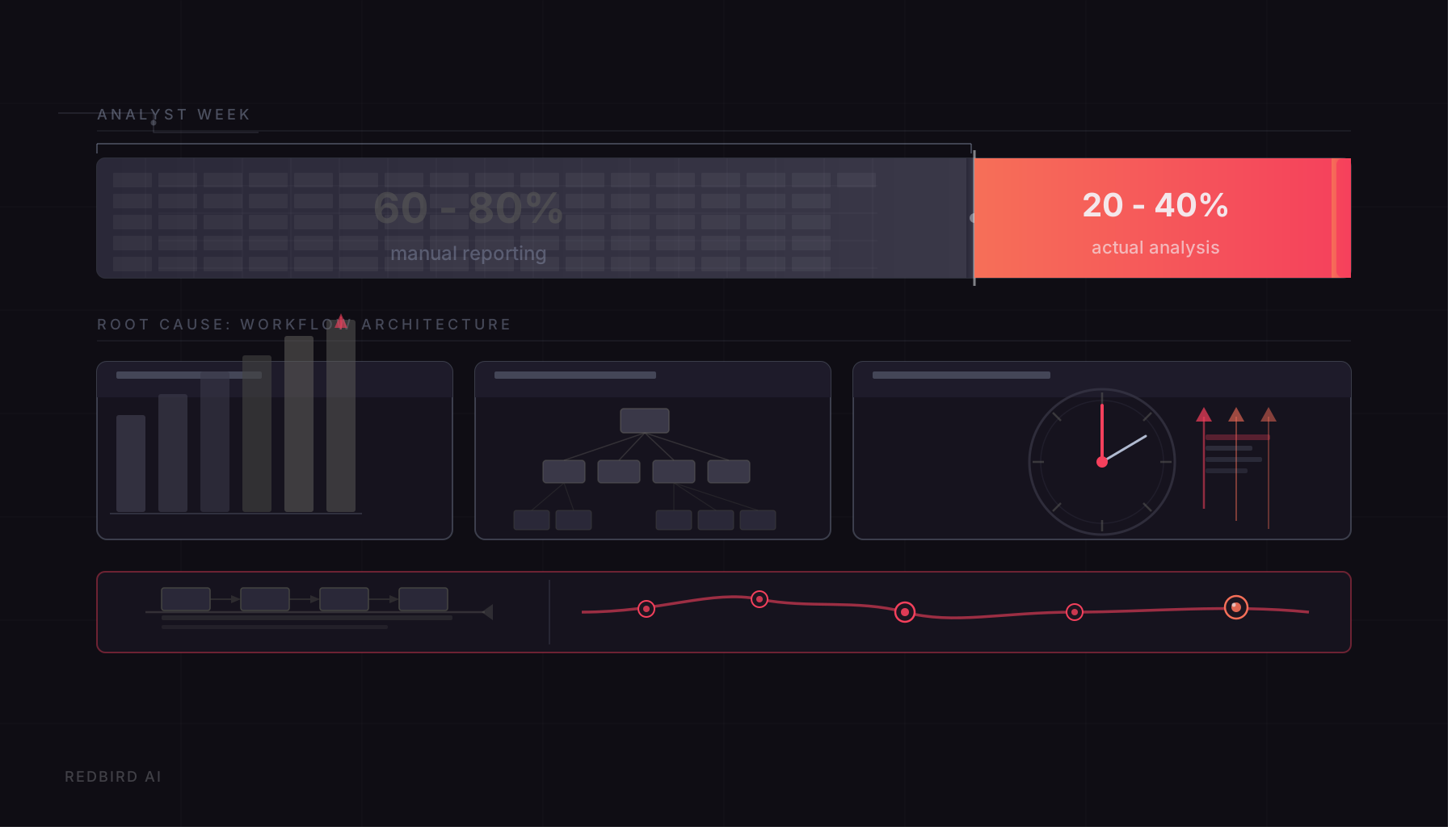
Despite meaningful advances in business intelligence platforms, cloud data warehouses, and AI-powered analytics tools, many analytics teams still spend 60-80% of their time preparing manual reports.
This isn’t a failure of talent. Most teams are staffed with capable analysts fluent in SQL, Python, spreadsheets, and modern BI tools. The problem is structural. The way analytics work gets executed has not evolved at the same pace as data volume, organizational complexity, or expectations for speed. As a result, even sophisticated teams remain locked in workflows dominated by preparation, coordination, and rework rather than analysis and decision-making.
In this context, manual reporting refers to the human effort required to collect data, reconcile metrics, validate results, and package analytics into business-ready outputs such as spreadsheets, dashboards, and presentations. While essential, this work consumes far more time than it should - and limits the impact analytics teams can have on the business.
What Analytics Work Actually Looks Like Today
In theory, analytics exists to surface insights and guide strategy. In practice, much of an analyst’s time is spent assembling the raw materials that make analysis possible. Data must be pulled from dozens of systems, reconciled across inconsistent schemas, cleaned, validated, and aligned to business definitions that are often undocumented or scattered across teams.
Even once analysis is complete, the work rarely ends there. Stakeholders want deliverables they can use immediately - Excel models they can explore, PowerPoint decks they can circulate, and summaries they can share with clients or leadership. That final step - contextualizing and packaging insights - remains largely manual and must be repeated every time a question changes or a reporting cycle begins.
Over time, analytics teams become reporting factories rather than insight engines.
Why Modern Analytics Tools Haven’t Eliminated Manual Reporting
At first glance, this appears to be a tooling problem. Organizations have invested heavily in BI platforms, cloud data warehouses, and AI assistants. But most of these tools address individual steps in the workflow rather than the analytics lifecycle as a whole.
Dashboards are powerful for visualization, but they rarely represent the final destination. Executives and clients don’t live inside BI environments. They consume analytics through presentations, spreadsheets, and written narratives - formats that still require analysts to manually recreate and update outputs on a recurring basis.
Text-to-SQL and natural language interfaces reduce friction in querying, but they assume the hard work has already been done. They don’t collect data, enforce business logic, orchestrate multi-step workflows, or generate downstream deliverables. Analysts remain responsible for validating results and stitching everything together.
Even organizations with strong data engineering teams struggle to escape this pattern. Centralized resources cannot keep pace with the rapid, iterative needs of business units, leaving analysts to maintain one-off pipelines and fragile workflows that quietly become permanent.
The Real Cost of Manual Reporting for Analytics Teams
The impact of manual reporting goes well beyond inefficiency. When workflows are slow and repetitive, insights arrive too late to influence decisions. Metric inconsistencies emerge as logic is reimplemented across spreadsheets, dashboards, and presentations. Trust in the data erodes, and teams spend more time debating numbers than acting on them.
There is also a human cost. Highly skilled analysts spend most of their time on repetitive, low-leverage work. Over time, this leads to frustration, burnout, and attrition - particularly among the people organizations depend on most to drive data-informed decision-making.
Perhaps most critically, manual reporting becomes a ceiling on advanced analytics and AI initiatives. Without reliable, automated execution, even sophisticated models struggle to reach production in ways that consistently deliver business value.
Why Manual Reporting Persists in Modern Analytics
Manual reporting persists because analytics is not a single task. It is a multi-step process that spans data collection, transformation, analysis, and delivery. Each step introduces opportunities for inconsistency, delay, and human intervention.
AI has begun to automate portions of this work, but most deployments remain narrow. Assistive tools can help draft queries or summarize results, yet they still depend on humans to provide context, verify accuracy, and manage the sequence of steps required to produce business-ready outputs.
In other words, intelligence has improved, but execution remains fragmented.
Many teams are understandably cautious about handing critical workflows to AI - and rightly so. Accuracy, governance, and repeatability matter. The path forward is not removing control; it is encoding it.
Solving the reporting problem requires more than faster dashboards or smarter queries. It requires systems that understand how data sources relate, how metrics are defined, and how outputs should be structured for different audiences. Without that context, automation breaks down and analysts are pulled back into the workflow.
This is why partial automation has failed to meaningfully reduce effort. The most complex parts of analytics - coordination, validation, and cross-step execution - have remained manual.
A Shift Toward Agentic Analytics Automation
A new execution model is emerging. Rather than treating analytics as a collection of disconnected tools, agentic platforms model workflows end-to-end and automate them through specialized AI agents that operate within defined boundaries.
Redbird is designed for this model. Instead of assisting with isolated tasks, it automates the lifecycle from data collection through transformation, analysis, and the creation of business-ready deliverables.
By embedding organizational context directly into the platform - data definitions, business logic, approval paths, and reporting standards - AI agents can execute workflows in ways that are consistent, repeatable, and auditable. Natural language requests are translated into deterministic steps, allowing teams to trust the outputs without constant manual reconstruction.
This does not eliminate human judgment. It changes where humans focus. Agents handle the repeatable mechanics of execution, while analysts provide supervision, manage exceptions, and refine how work should be done.
The system improves not through blind autonomy, but through structured collaboration between people and software.
Just as data warehouses industrialized storage and BI standardized visualization, agentic systems are beginning to industrialize execution.
The result is not simply faster answers, but finished work: presentations, spreadsheets, dashboards, and insights that are immediately usable by the business.
What This Means for Analytics Teams
When manual reporting is removed from the critical path, the role of the analyst changes fundamentally. Time previously spent assembling and validating data is reclaimed for interpretation, experimentation, and strategic thinking. Teams can respond to questions in minutes rather than days, and advanced analytics becomes part of everyday decision-making rather than a specialized effort.
Analytics shifts from a service function to core operating infrastructure.
From Manual Reporting to Autonomous Analytics
The fact that 60-80% of analytics time is still spent on manual reporting is not an indictment of today’s teams - it’s a sign that the execution model is outdated. As data ecosystems grow more complex and expectations accelerate, automation must extend beyond visualization and querying to encompass the entire workflow.
Organizations that adopt this model first will not simply save time. They will operate at a different tempo. Decisions will compound faster, teams will scale further, and analytics will become foundational to how the business runs.
If your team is spending more time preparing reports than generating insights, it may be time to rethink how analytics work gets done.
Request a demo to see how Redbird automates reporting workflows end to end - and helps teams move from manual reporting toward truly autonomous analytics.