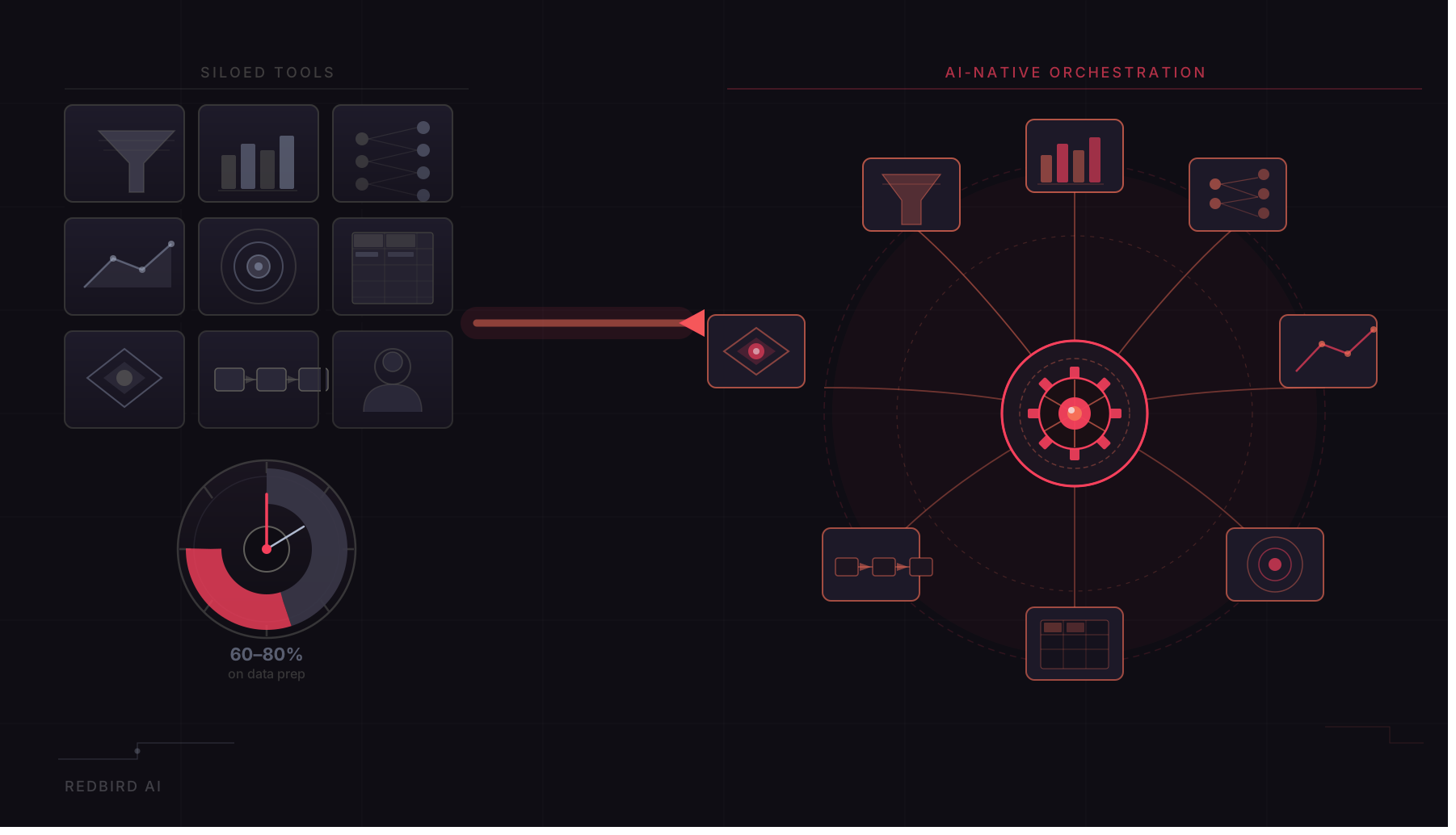
Marketing teams didn’t run out of dashboards - they ran out of time. In many organizations, the constraint isn’t access to data; it’s the human work required to turn scattered sources into something consistent, trustworthy, and presentation-ready. Weekly leadership updates. Monthly client performance reviews. Campaign pacing discussions. Budget reallocation meetings. When reporting cycles are weekly - or even daily - the preparation layer quietly becomes the job: collecting extracts, cleaning inconsistent naming conventions, reconciling what “counts” across platforms, aligning ad spend to pipeline and revenue, rerunning queries after API changes, and translating numbers into narratives that stakeholders and clients can act on. It’s common for organizations to spend the majority of their analytics capacity on this preparation layer rather than on insight and decision-making, often 60–80% of a data team’s week.
Marketing teams feel this pressure first because they operate at the highest velocity. Budgets shift weekly. Campaign structures evolve. New channels are tested. Attribution models change. When infrastructure cannot keep pace with marketing iteration speed, analysts become the integration layer - manually reconciling channel performance with CRM stages, subscription revenue, refunds, or finance systems just to produce consistent CAC, LTV, and ROI views.
That’s why the category of marketing data platforms has expanded so rapidly. Over the past decade, the market has largely been defined by connector-first and warehouse-first architectures: platforms that move marketing data into spreadsheets, BI tools, or centralized warehouses. These tools meaningfully reduce friction. But as organizations mature, the question shifts from “How do we centralize data?” to “How do we automate the recurring workflow surrounding it?”
This is where architectural differences begin to matter.
Supermetrics
Supermetrics built its reputation by solving a critical operational problem: reliable extraction of advertising and web analytics data into the tools marketers already use. It connects directly to major ad platforms and analytics systems, handles API maintenance, supports reusable queries, and enables scheduled refreshes.
For agencies and performance teams managing multiple accounts, this creates real efficiency. Standardized client reporting templates can be automated. Channel dashboards refresh without manual exports. In many environments, Supermetrics reduces the operational burden of data access substantially.
Supermetrics has also expanded beyond basic extraction, supporting transformation logic and reusable data pipelines within its environment. However, in most architectures it functions primarily as a data delivery layer rather than the centralized system of record for cross-functional metric governance and complex multi-source reconciliation. When reporting requires deeper integration across CRM systems, subscription revenue, finance data, or cohort-based LTV modeling, additional modeling and orchestration layers are typically introduced. Supermetrics plays an important role in many stacks, but it does not usually own the entire reporting lifecycle.
Improvado
Improvado positions itself as an enterprise marketing analytics platform, combining data extraction, normalization, and standardized reporting. It supports ingestion and harmonization of cross-system KPI data, including CRM and revenue sources, making it more comprehensive than simple connector tools.
For organizations managing numerous brands, regions, or campaign structures, Improvado’s governance and harmonization capabilities can significantly reduce inconsistency. It provides structured KPI frameworks designed to standardize definitions of ROAS, CPA, CAC, and other metrics across teams.
The architectural question for many organizations is less about integration capability and more about lifecycle ownership. As analytical needs expand into multi-step reconciliations, predictive modeling, anomaly investigation, and recurring executive or client deliverables, the configuration and maintenance of those workflows often spans multiple systems and internal resources. Improvado strengthens the marketing data foundation considerably, but deeper workflow automation may still require coordination across tools.
Segment
Segment, part of Twilio, operates in the Customer Data Platform category. Segment specializes in event collection, identity resolution, and real-time routing of customer data across systems.
In many modern architectures, Segment serves as foundational infrastructure for unified customer views. It drives consistent event tracking, feeds warehouse models, and enables downstream reporting and activation. For product-led growth and lifecycle marketing teams, this capability is critical.
Segment is typically positioned as upstream infrastructure rather than as the primary engine for automated cross-system reporting and deliverable generation. It excels at standardizing behavioral data flows, but the orchestration of executive reporting workflows and multi-source reconciliation generally lives in downstream systems. Segment strengthens the plumbing of customer data but does not usually centralize reporting automation.
Funnel and Adverity
Funnel and Adverity both focus on aggregating and standardizing advertising and campaign data at scale. These platforms automate large portions of marketing data harmonization and reporting preparation, particularly for agencies and multi-brand enterprises.
Funnel emphasizes transforming fragmented marketing data into consistent schemas suitable for analysis and export. Adverity positions itself as an enterprise-grade data management platform for marketing analytics, incorporating governance and transformation capabilities.
Both platforms meaningfully automate components of analytics workflows. As analytical complexity expands into multi-system reconciliation, predictive analytics, and fully formatted executive or client deliverables, additional layers are often introduced to manage those processes. They reduce data chaos and preparation burden, but full lifecycle orchestration may still be distributed.
The Structural Pattern Across the Stack
Across the marketing data platform landscape, a consistent pattern emerges. Most platforms solve critical layers of the stack - connectivity, harmonization, ingestion, event tracking, or modeling. In well-designed composable architectures, many aspects of analytics workflows can indeed be automated.
The distinction is not whether automation exists. It’s where orchestration lives.
In many environments, ingestion is handled by one system, transformation by another, business logic by dbt models, dashboards by BI tools, and presentation deliverables by analysts. Each layer may be automated individually, but the coordination between layers - especially when metrics change, new sources are added, or executives request new cuts - often remains operationally heavy.
The consequence is subtle but significant. Campaign optimization slows because reconciliations take time. Budget reallocation lags because revenue alignment requires cross-system validation. Client narratives drift because reporting logic lives in multiple places. Even with strong infrastructure, the recurring reporting cycle can still depend on human coordination.
That coordination burden is what defines the next phase of the category.
The Shift Toward AI-Native Orchestration
The emerging shift in marketing data infrastructure is not about replacing composable stacks. It’s about reducing the operational overhead required to coordinate them.
AI-native platforms are designed to centralize lifecycle orchestration - translating requests into structured, multi-step workflows that span ingestion, harmonization, metric calculation, anomaly detection, and formatted deliverable generation.
This is an architectural distinction.
Rather than relying on distributed automation across separate systems, orchestration becomes a first-class layer. Context - including metric definitions, data ontologies, report templates, and business logic - is captured explicitly and applied consistently. Requests are routed through deterministic workflows, increasing reliability and auditability.
The result is not merely faster dashboards. It is the automation of recurring reporting cycles - including fully formatted PowerPoint presentations, Excel files, and executive-ready materials generated directly from governed data.
The shift is from component automation to workflow automation.
Why Redbird Is Architected for Workflow Automation
Redbird is designed specifically around this orchestration-first model.
Redbird sits on top of existing data ecosystems - connecting to warehouses, enterprise systems, raw files, marketing platforms, and even systems without APIs - without requiring a rip-and-replace of core infrastructure. Its AI agent ecosystem coordinates data collection, transformation, analytics, anomaly detection, and output generation across the full lifecycle.
What differentiates the architecture is not that other tools cannot automate parts of the process. It is that Redbird centralizes orchestration of the entire workflow within a unified agentic system.
Instead of distributing ingestion, modeling, analytics, and deliverables across multiple tools and teams, Redbird compresses that coordination into a single automation layer. The platform’s routing and orchestration framework ensures that natural language requests are translated into structured, auditable workflows rather than isolated queries.
For marketing organizations, this translates into tangible outcomes:
Campaign performance reports that automatically reconcile spend to revenue impact.
Consistent CAC and LTV logic applied across systems without manual recalculation.
Proactive alerts when channel performance deviates from expected ranges.
Standardized client and leadership deliverables generated without manual assembly.
Rather than adding another component to the stack, the goal becomes eliminating the recurring coordination burden itself.
The Strategic Choice
Supermetrics, Improvado, Segment, Funnel, and Adverity all solve meaningful and important problems. In many organizations, they will remain part of the architecture.
The strategic decision is not which tool has features. It is where workflow ownership resides.
If orchestration remains distributed across ingestion tools, transformation frameworks, BI layers, and manual presentation workflows, reporting automation will remain partial.
If orchestration is centralized within an AI-native system designed to automate the lifecycle end-to-end, reporting becomes infrastructure.
That is the architectural distinction defining the next generation of marketing data platforms - and it is the design principle Redbird was built around.