Agentic analytics is quickly becoming one of the most important conversations in enterprise data.
The promise is powerful: AI systems that can autonomously collect information from disparate sources, apply business logic, perform analysis, and return production-ready deliverables in response to a simple request. Instead of waiting days or weeks for a report, teams can move at the speed of a question.
Yet for all the excitement, many organizations underestimate the operational reality of introducing agents into environments where accuracy, governance, and stakeholder trust have been built over years.
When implementations struggle, it is rarely because the algorithms fail. It is because the rollout disrupts the social and technical contracts that already exist inside the business.
- Metrics suddenly look different.
- Familiar templates disappear.
- Validation steps are bypassed.
- Ownership becomes unclear.
The result is predictable: hesitation, shadow processes, and eventually a retreat back to manual work.
Successful organizations recognize a fundamental truth:
The goal is not to impress users with intelligence.
The goal is to prove that nothing breaks while everything gets faster.
This guide outlines a practical approach leaders can use to introduce agents safely, accelerate adoption, and create measurable value within weeks rather than quarters.
Why Agentic Analytics Initiatives Stall
Most companies begin their journey with the wrong mental model. They treat agents like a brand-new BI platform or a transformation initiative that requires dramatic change.
From the perspective of the business, however, radical change equals risk.
Stakeholders who rely on analytics to run campaigns, close books, or report to clients are not looking for novelty. They want continuity and reliability. They need to know that the numbers will match last month, that definitions remain intact, and that outputs will appear in formats they recognize.
When an AI initiative introduces uncertainty in any of these areas, even if the automation is technically superior, confidence erodes immediately.
Adoption fails not because the system lacks capability, but because it violates expectation.
Principle #1: Add a Layer, Don’t Create a Replacement
The most successful rollouts avoid the temptation to rebuild the stack. They introduce agents as an orchestration and productivity layer that sits on top of the existing ecosystem.
Data warehouses remain the source of truth.
Enterprise systems continue to operate as they always have.
Approved calculations, templates, and governance processes persist.
By positioning agents as accelerators rather than replacements, leaders dramatically reduce resistance from IT, analytics, and business stakeholders alike. Users can continue working in the environments they know while benefiting from radical improvements in speed and scale.
This approach also shortens time to value. Instead of spending months migrating assets, teams can begin automating almost immediately.
Principle #2: Context Is the Real Intelligence
A common misconception is that smarter models automatically produce better outcomes. In enterprise analytics, the opposite is often true.
Accuracy is not a function of generative capability. It is a function of how well the system understands the organization.
Agents need deep awareness of data structures, metric definitions, transformation logic, and reporting standards. They must know not only how to compute revenue, but whose definition of revenue is considered authoritative. They must recognize which adjustments are approved and which shortcuts are unacceptable.
Without this context, automation scales inconsistency.
With it, agents can reproduce institutional knowledge with remarkable precision.
Capturing and operationalizing context is therefore the most important investment any organization can make during rollout.
Principle #3: Begin With Friction, Not Vision
Vision is important, but it rarely motivates adoption.
Pain does.
The fastest path to traction is identifying workflows where talented analysts spend disproportionate time on mechanical preparation rather than thinking. These are typically recurring deliverables that require collecting data from multiple systems, reconciling formats, applying standardized calculations, and packaging results for distribution.
When agents remove this burden, the impact is obvious and immediate. Teams feel relief rather than disruption.
Momentum built in these areas becomes the foundation for broader transformation later.
Principle #4: Reliability Must Precede Autonomy
Demonstrations of free-form AI can be captivating, but production environments demand more than impressive conversations.
They require repeatability, audit trails, and deterministic execution. Leaders must be able to answer fundamental questions: Where did this number come from? What logic was applied? Would we obtain the same result tomorrow?
Systems that cannot provide these assurances will struggle to gain approval beyond experimentation.
The most effective architectures therefore use AI to translate human intent into structured workflows executed by specialized components. Autonomy exists, but it operates within boundaries that preserve enterprise standards.
A Practical Rollout Framework
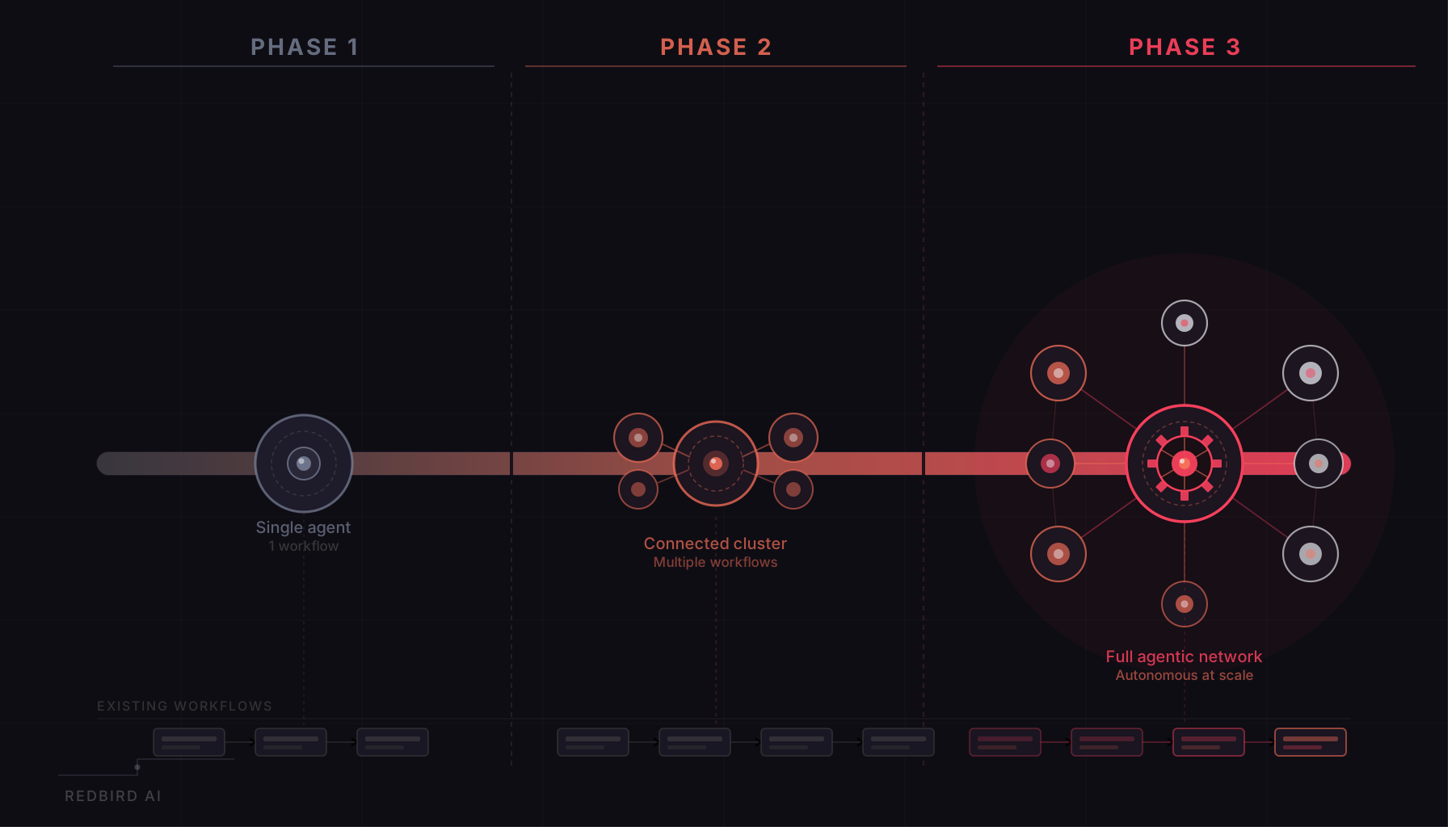
Organizations that succeed tend to follow a consistent progression from validation to scale.
Step 1 - Reproduce the Existing Output
Before attempting optimization, agents should replicate today’s process exactly. This includes data sources, calculations, formatting, and approval paths. The objective is equivalence, not improvement.
Matching the current state eliminates fear and establishes a baseline for trust.
Step 2 - Run Parallel Operations
For a defined period, automated and manual processes should operate simultaneously. Differences are investigated, logic is refined, and stakeholders gain visibility into how outcomes are produced.
This stage is essential. Confidence built here enables every step that follows.
Step 3 - Quantify the Productivity Release
Once parity is achieved, organizations can clearly measure how much time has been returned to the team.
Many discover that analysts previously spent the majority of their week assembling information rather than interpreting it.
Framing automation in terms of recovered capacity resonates strongly with executives and finance leaders.
Step 4 - Expand the Circle of Access
After reliability is proven, similar workflows can be opened to adjacent users. Because definitions and governance are already embedded, scaling does not introduce additional risk.
Self-service becomes realistic rather than aspirational.
Step 5 - Introduce Advanced Capabilities
Only after a stable foundation exists should organizations push into forecasting, anomaly detection, or prescriptive automation.
Innovation lands successfully when users already trust the system.
What To Do
- Invest heavily in documenting business logic and institutional knowledge.
- Maintain familiar delivery formats so stakeholders experience continuity.
- Provide transparency into how agents execute each task.
- Position automation as a way to elevate analysts into more strategic roles.
- Communicate early wins broadly to build internal advocacy.
What Not To Do
- Do not require teams to abandon existing infrastructure.
- Do not equate conversational interfaces with analytical reliability.
- Do not rush directly to full autonomy.
- Do not hide methodology behind opaque systems.
- Do not underestimate the cultural change required for adoption.
Where ROI Materializes First
Returns tend to appear fastest in environments where reporting demand is high, turnaround expectations are tight, and technical support is limited. Marketing, finance, and insights functions often fit this profile.
Here, agents dramatically reduce dependency bottlenecks, standardize outputs, and allow experts to redirect energy toward strategy and experimentation rather than assembly.
The Organizational Shift That Unlocks Scale
Perhaps the most important outcome of agentic analytics is not faster reporting, but the redefinition of human contribution.
As preparation becomes automated, analysts transition into roles that emphasize judgment, communication, and innovation. They become partners to the business rather than service providers.
This evolution is what ultimately multiplies enterprise value.
The Bottom Line
Rolling out agentic analytics successfully requires discipline.
Leaders must protect trust, preserve continuity, and introduce change in ways that feel supportive rather than threatening. When automation removes friction while honoring established standards, adoption accelerates naturally.
Do this well, and agents become part of the organization’s operating fabric.
Do it poorly, and even the most advanced technology will sit unused.