Segment built its reputation as the connective tissue of the modern data stack. At its core, it was designed to collect events from digital products, standardize them, and route them to the downstream tools that marketing, product, and growth teams depended on. For engineering teams and growth-oriented organizations standing up a customer data pipeline in the mid-2010s, it was a genuinely transformative tool. But the landscape of analytics and reporting work has shifted substantially, and the needs of today's analytics teams have outgrown what Segment was designed to do.
The teams most acutely feeling this friction are not engineering teams configuring event schemas. They are business analysts in finance, marketing, and research who need to pull data from a dozen different sources, transform and reconcile it, run calculations against it, and produce outputs that go directly into client presentations, executive dashboards, and operational reports. These teams need more than a data routing layer. They need a platform that handles the full lifecycle from ingestion through transformation through insight delivery, and that does so in a way that does not require a data engineering team standing behind every workflow.
This guide evaluates the most credible Segment alternatives available in 2026, assesses their genuine strengths and limitations, and helps analytics and reporting teams identify which tool fits their actual situation. The goal is not to find a tool that does what Segment does but better. It is to find a tool that does what Segment was never really designed to do.
What Segment Does Well, and Where It Hits Its Limits
Segment's core product, the customer data platform, remains genuinely strong for its intended purpose. If your organization needs to capture behavioral events from a web or mobile application, normalize them into a consistent schema, and fan them out to advertising platforms, CRMs, and analytics tools, Segment does that work reliably and at scale. Its Connections product gives engineering teams a centralized place to manage integrations with hundreds of downstream destinations, eliminating the brittleness of point-to-point integrations built directly into application code. For companies where the primary data challenge is instrumentation quality and downstream routing, Segment is a well-designed solution with a mature ecosystem.
The limitations become apparent when analytics and reporting teams try to use Segment as the foundation for operational reporting and business intelligence work. Segment is not a transformation layer in any meaningful sense. The data it routes arrives at destinations largely as it was collected, which means the reconciliation, metric calculation, and business logic that analysts need to apply must happen somewhere else, typically in a warehouse and a separate transformation tool. Segment also does not produce outputs. There are no reports, no scheduled deliverables, no formatted exports. It moves data from one place to another and expects other tools to take over from there. For engineering teams that have those other tools in place, this is a reasonable division of labor. For analytics teams that need an end-to-end solution and do not have dedicated data engineering support, it creates a gap that Segment was never designed to fill.
There is also a meaningful question about who can actually use it. Standing up and maintaining a Segment implementation requires technical knowledge of event tracking, schema design, and API configuration that most business analysts do not have and should not need to develop. When the team most affected by the data cannot operate the tool themselves, the tool creates dependency rather than enabling self-service. That dependency is manageable in organizations with strong engineering support, but it is a real cost that should be factored into any evaluation.
What to Look for in an Alternative
Evaluating Segment alternatives requires being precise about what problem you are actually solving, because the tools in this space serve very different needs. The right framework for analytics and reporting teams centers on a handful of dimensions that Segment itself does not fully address.
Connectivity breadth matters, but depth matters more. Most tools in this space can connect to popular SaaS platforms and cloud warehouses. The meaningful differentiator is whether a tool can reach the awkward sources: on-premise databases, legacy enterprise systems, internal portals that expose no API, and proprietary file-based workflows. Teams that only need clean API connections to modern SaaS tools have many options. Teams with messier data environments need to evaluate connectivity more carefully.
Transformation capability is where many tools fall short. Ingesting data from multiple sources is the beginning, not the end. The work of harmonizing schemas, deduplicating records, applying business logic, and calculating metrics consistently across outputs is where most of the analytical labor actually lives. A tool that can only move data, not transform it, leaves that work to be done manually or requires additional infrastructure that adds cost and complexity.
Analyst accessibility is a dimension that is easy to underweight. A platform that requires SQL proficiency or Python knowledge to operate excludes a large portion of the people who most need access to data. Conversely, a platform that is accessible to analysts should not sacrifice power for technical users who want to build and own complex workflows. The best tools in this space serve both constituencies without requiring separate platforms.
Output format matters significantly for reporting-oriented teams. If your team's deliverables are Excel files and PowerPoint presentations, a tool that only outputs dashboards or sends data to a visualization layer is solving the wrong problem. The final mile of the analytics workflow, producing the actual document that a client or executive will look at, is where a surprising amount of time gets spent, and most data tools ignore it entirely.
Finally, governance and auditability are increasingly non-negotiable for teams working in regulated industries or producing client-facing deliverables. When a number in a report is questioned, teams need to be able to trace exactly where it came from, what transformations were applied, and when the pipeline last ran. Tools that treat the execution layer as a black box create risk that compounds over time.
The Main Alternatives
Rudderstack
Rudderstack is the most direct competitor to Segment, offering a similar customer data platform with event collection, schema management, and destination routing at its core. Its key differentiator from Segment has historically been its open-source foundation, which gives engineering teams greater control over their infrastructure and data residency. Rudderstack has also invested more heavily in transformation capabilities within the pipeline, which gives technical teams more flexibility to manipulate data before it reaches downstream destinations. For organizations that are committed to the CDP model and want more control than Segment's fully managed offering provides, Rudderstack is a credible choice. The limitation for analytics and reporting teams is the same as with Segment: it is fundamentally an engineering tool. Configuring sources, managing schemas, and building transformations requires technical expertise, and the platform does not produce reporting outputs. Teams migrating from Segment to Rudderstack are solving for infrastructure control, not for analyst self-service.
Fivetran
Fivetran occupies a different part of the data stack. Where Segment focuses on event tracking from product surfaces, Fivetran focuses on replicating data from operational systems into a central warehouse. Its strength is the depth and reliability of its connector library, which covers hundreds of data sources and maintains those connectors as source APIs change. For teams whose primary challenge is getting data from SaaS tools, databases, and enterprise systems into Snowflake, BigQuery, or Redshift reliably and without maintenance overhead, Fivetran is genuinely excellent at that job. The important limitation to understand is that Fivetran stops at the warehouse door. It does not transform data, it does not run analytics, and it does not produce outputs. It is an ingestion layer, and it needs to be paired with a transformation tool and a reporting or BI layer to be useful for analytics teams. That makes Fivetran a component of a solution rather than a solution in itself, which is fine if you have the rest of the stack in place but adds meaningful complexity and cost if you do not.
dbt
dbt (data build tool) has become the standard for SQL-based data transformation within the modern data stack and has earned its prominence. For engineering and analytics engineering teams, it provides a clean, version-controlled, test-driven way to define transformation logic on top of a cloud warehouse. Its templating system, modular design, and integration with orchestration tools like Airflow make it a powerful foundation for building reliable data models that serve downstream reporting and analysis. The honest limitation is that dbt is a technical tool that assumes SQL proficiency and familiarity with software engineering practices like version control and testing. It is not accessible to business analysts without significant support, and it does not produce reporting outputs on its own. dbt is also a transformation layer only; it relies on something like Fivetran upstream for ingestion and something like Looker or Tableau downstream for reporting. For organizations with mature analytics engineering functions, dbt is an excellent tool. For teams looking for an end-to-end solution that does not require assembling multiple components and the expertise to maintain them, dbt is a piece of the puzzle, not the whole picture.
Airbyte
Airbyte is the open-source alternative to Fivetran, offering a large and community-maintained connector library with the flexibility of self-hosted or cloud-managed deployment. Its primary appeal is cost and control: teams that want to avoid per-row pricing or that need to build custom connectors for proprietary sources will find Airbyte more accommodating than commercial alternatives. The tradeoffs are maintenance burden and maturity. Self-hosted Airbyte requires engineering resources to operate and update, and connector quality across the library is more variable than with a commercially maintained catalog. Like Fivetran, it is an ingestion tool that stops at the warehouse and needs the rest of the stack to be useful for analytics and reporting teams.
Looker and Amplitude
Looker and Amplitude represent a different category of alternative: tools that address the reporting and analysis layer rather than the ingestion and transformation layer. Looker, now part of Google Cloud, provides a governed semantic layer and dashboarding environment that sits on top of a warehouse, giving business users a self-service interface for exploring data and building reports. Amplitude focuses specifically on product and behavioral analytics, providing deep event analysis, funnel visualization, and retention metrics out of the box. Both are strong products within their domains. The limitation for teams looking at these as Segment replacements is that they assume the data has already been collected, cleaned, and modeled. They are consumers of a data pipeline, not the pipeline itself. A team moving off Segment still needs to solve for ingestion and transformation before these tools become useful, which means the total solution requires additional components and the expertise to assemble them.
Redbird: An Alternative Built for the Full Analytics Lifecycle
Redbird occupies a fundamentally different position from the tools described above because it is not designed to do one part of the data lifecycle well. It is designed to handle all of it, from connecting to source data through transformation, analysis, and output delivery, within a single platform. That distinction matters most for analytics and reporting teams that have been assembling multi-tool stacks and absorbing the complexity, cost, and brittleness that come with them.
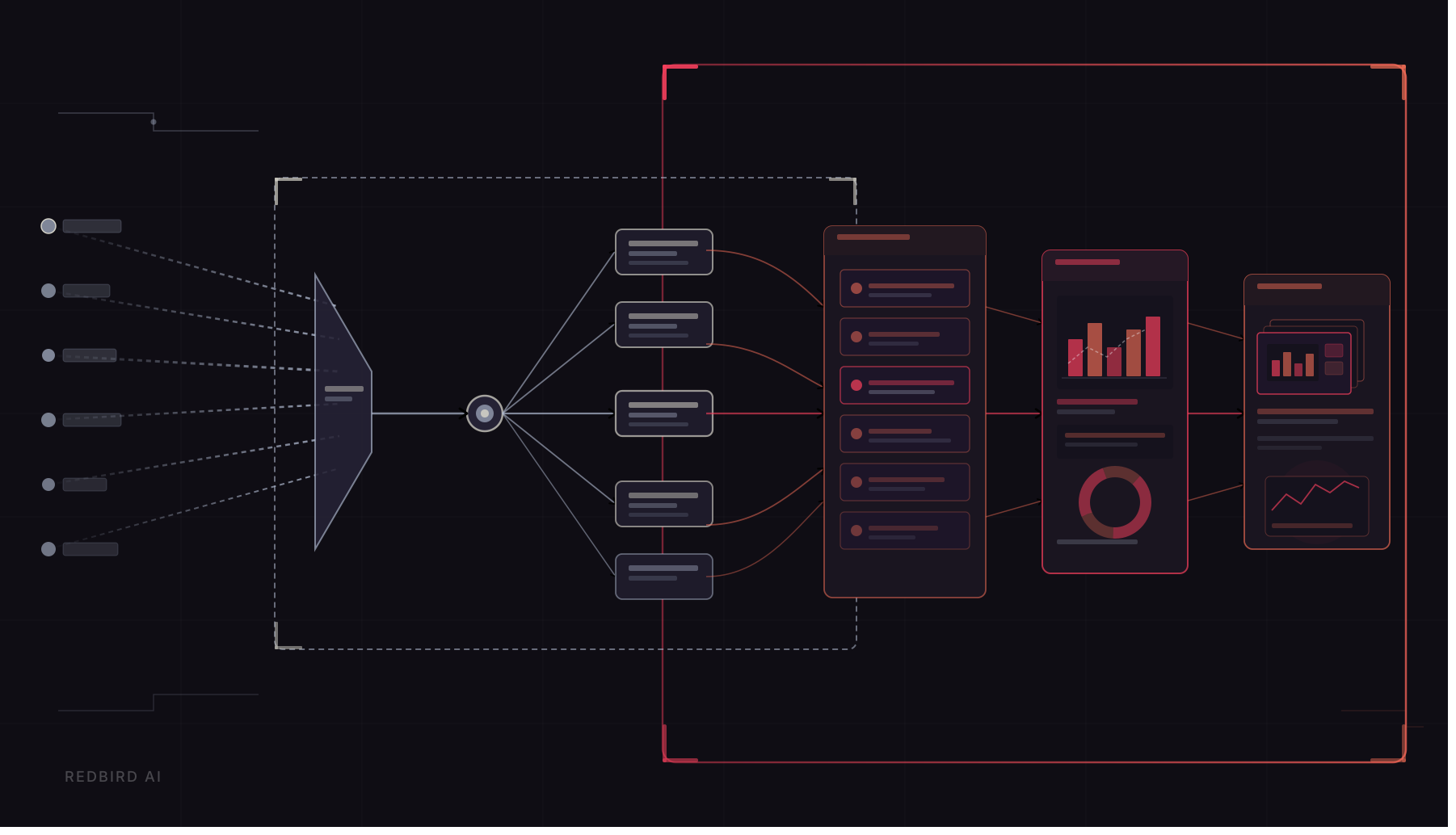
The platform's architecture is built around a coordinated ecosystem of specialized AI agents, each responsible for a discrete function in the data workflow. When a user submits a request, a routing agent interprets the intent and dispatches work to the appropriate specialists: data collection agents pull from source systems, a data engineering agent harmonizes and transforms the data, an analyst agent applies business logic and computes metrics, a data science agent handles modeling and forecasting workloads, and a reporting agent assembles the final deliverable. This multi-agent design allows the platform to handle complex, multi-step workflows that would require manual coordination across multiple tools in a traditional stack.
A critical aspect of how Redbird achieves enterprise-grade accuracy is its use of deterministic orchestration rather than LLM-driven execution. This distinction is more significant than it might appear. Tools that rely on large language models to execute analytical tasks, the category sometimes called text-to-SQL, introduce meaningful accuracy risks because LLMs are probabilistic: they produce plausible outputs, not guaranteed ones. Redbird uses language models for a narrow purpose, interpreting user intent and routing requests, and then executes the actual data work through a deterministic orchestration layer that translates those instructions into step-by-step, auditable workflows. Every transformation applied, every calculation performed, and every output generated is logged and fully reviewable. For teams producing client deliverables or operating in regulated environments, this is not a nice-to-have feature. It is a prerequisite.
On the connectivity side, Redbird is designed to reach sources that other tools in this space struggle with. Beyond standard API connections to cloud warehouses and SaaS platforms, it uses robotic process automation to extract data from legacy systems, internal portals, and proprietary tools that expose no standard interface. For organizations whose data is not neatly organized in modern cloud infrastructure, this matters considerably.
Where Redbird most clearly differentiates itself for analytics and reporting teams is in how it handles the final mile of the workflow. Most data platforms assume that the output is a dashboard or a query result. Redbird assumes that the output is a document that a human will actually use: a formatted Excel workbook, a populated PowerPoint presentation, or a Word report. The platform can apply an organization's existing templates, branding standards, and layout specifications to produce deliverables that are ready to send, not raw data exports that require manual formatting. For teams that spend significant time each week turning data into polished outputs, this capability alone represents a substantial reduction in manual work.
The platform is also designed to serve both technical and non-technical users within the same environment. Business analysts who are not comfortable writing SQL can describe what they need in natural language and receive a complete, formatted deliverable. Data engineers and technical analysts who want to author pipelines directly, integrate custom Python models, or extend agents with specific business logic can do that within the same platform. One governance layer, one audit trail, and one set of data definitions serve the entire team regardless of technical background.
How to Choose: Matching the Tool to Your Team's Reality
The right answer depends almost entirely on where your team's primary bottleneck sits and what kind of organization you are operating within. If your core challenge is CDP infrastructure, specifically collecting and routing behavioral events from digital products to marketing and growth tools, Rudderstack is the most direct Segment alternative and offers more control over your infrastructure. If your challenge is reliable data replication from many operational sources into a warehouse you already have, Fivetran or Airbyte will serve you well, with Fivetran offering more managed reliability and Airbyte offering more flexibility and lower cost at the price of greater maintenance. If your team has strong analytics engineering capacity and the core need is a governed transformation layer that sits on top of an existing warehouse, dbt is the right tool for that specific job.
The teams for whom Redbird is the most logical choice are those where the bottleneck is not any single part of the data lifecycle but the entire workflow from source to deliverable. This is typically the situation for business-facing analytics teams, marketing and research functions, finance teams that produce regular reporting packages, and consultancies or agencies that produce client deliverables at scale. These are teams that often lack dedicated data engineering support, that work with data from a wide variety of sources, and that need their outputs to look like finished work rather than raw data. It is also the right fit for larger organizations where centralized data engineering teams cannot keep up with the volume and velocity of reporting requests from business units, and where empowering analysts to own their workflows directly would free up engineering capacity for higher-order work.
The honest consideration for any of these tools is total cost of ownership across the full stack. A tool that costs less in licensing but requires additional components to be complete, and the engineering resources to assemble and maintain them, may cost more in practice than a more comprehensive platform that eliminates those dependencies. Teams evaluating alternatives to Segment should scope the full solution they need, not just the component that replaces what Segment currently does.
Conclusion
Segment remains a strong tool for the problem it was designed to solve. But the needs of analytics and reporting teams in 2026 extend well beyond event routing and CDP infrastructure. The teams doing the most consequential data work today need platforms that can connect to diverse and messy data sources, transform that data reliably, apply business logic consistently, and produce outputs that people can actually use without spending hours on formatting and assembly.
The alternatives covered in this guide each address part of that picture. Rudderstack and Fivetran solve for infrastructure. dbt solves for transformation. Looker and Amplitude solve for exploration and visualization. Redbird is the option for teams that need all of those layers to work together without building and maintaining the connections between them. For analytics and reporting teams that have spent too long patching together multi-tool stacks and absorbing the overhead that comes with them, that end-to-end capability is what makes a meaningful difference in day-to-day work.