Fivetran has become a standard fixture in the modern data stack, and for good reason. It does one thing extremely well: moving data from source systems into a warehouse, reliably and with minimal fuss. For organizations where that is the core problem, it is a capable solution. But for analytics and reporting teams, the data pipeline is rarely the endpoint. It is the beginning of a much longer, more labor-intensive process that Fivetran was never designed to handle, and that gap has become harder to ignore as the demands on these teams have grown.
The teams feeling this most acutely are not necessarily the ones building complex data infrastructure. They are marketing analysts pulling spend data from six different ad platforms, finance teams reconciling numbers across systems to produce a monthly board deck, and research teams stitching together disparate datasets to generate client-facing reports. For these teams, Fivetran solves the ingestion step but leaves everything after it, the transformation, the analysis, the formatting, the delivery, as a manual exercise. The question many of them are now asking is whether there is a better way to think about the entire workflow, not just the pipeline.
This guide is for analytics and reporting teams who are asking that question. It covers the most relevant Fivetran alternatives in 2026, what each is actually built to do, and how to think about which category of tool matches the problem you are actually trying to solve.
Understanding What You Actually Need
Before evaluating alternatives, it is worth being precise about where Fivetran fits and where it does not. Fivetran is an ELT (extract, load, transform) tool, meaning it extracts data from source systems, loads it into a destination, and leaves the transformation for downstream tools. It is not an analytics platform. It does not help you build reports, validate business logic, or produce deliverables. It is a plumbing tool, and a good one, but it sits at only one stage of the workflow that analytics and reporting teams actually live in.
This matters because most of the frustration people attribute to Fivetran is not really about Fivetran. The data gets to the warehouse on schedule. The problem is everything that happens next: analysts writing SQL by hand, building pivot tables in Excel, manually updating PowerPoint decks, and chasing down data discrepancies that take hours to diagnose. If that is where the pain is, the answer is probably not a better pipeline tool. It is a different category of solution entirely.
That said, there are legitimate reasons to look for a Fivetran replacement or supplement. Pricing is a common one: Fivetran's MAR-based pricing model can become difficult to forecast as data volumes grow. Connector coverage is another: if your team relies on niche or proprietary data sources, Fivetran's catalog may not reach them. And for teams that need transformation capabilities, the reliance on dbt as a separate tool adds complexity and another dependency to manage.
The alternatives below span several categories, from purpose-built ELT tools to broader automation platforms. Understanding which category matches your actual workflow problem is more useful than any feature comparison.
Airbyte
Airbyte is an open-source data integration platform that competes most directly with Fivetran in terms of core functionality. It handles data movement from source to destination and has built an extensive connector library, including the ability for teams to build custom connectors, which is a meaningful advantage over Fivetran when working with non-standard data sources. The open-source version can be self-hosted, which appeals to organizations with strict data residency requirements or those that find Fivetran's pricing difficult to justify. Airbyte Cloud offers a managed version for teams that do not want to operate the infrastructure themselves.
The tradeoff is operational overhead. Self-hosting Airbyte requires someone to own the infrastructure, manage upgrades, and troubleshoot failures. For data engineering teams with the capacity to do that, it is a reasonable exchange for cost control and flexibility. For analytics and reporting teams without dedicated engineering support, it introduces a maintenance burden that often negates the cost savings.
Like Fivetran, Airbyte does not address the post-ingestion portion of the workflow. Data reaches the warehouse, and from there, the team is on its own.
dbt (data build tool)
dbt is the dominant tool for data transformation within the modern data stack and is often used alongside Fivetran rather than as a replacement for it. It allows data teams to define transformations in SQL, version-control them, test data quality, and build a documented lineage of how raw data becomes the tables analysts query. For organizations with a mature data team that owns the pipeline and cares deeply about transformation governance, dbt is excellent.
For analytics and reporting teams evaluating it as a Fivetran alternative, it is worth being clear about what dbt actually is. It is a transformation tool for people comfortable writing SQL, not a no-code solution. It requires a data engineering function to implement and maintain. It does not ingest data, produce reports, or deliver business outputs. If the goal is to reduce the manual work that analytics teams do every day, dbt addresses only one piece of that problem and requires significant technical investment to implement correctly.
Stitch
Stitch, now part of Talend (which itself became part of Qlik), is a simpler, more affordable take on ELT. It covers the core use case of moving data from popular SaaS sources into a warehouse, with a lighter interface and lower price point than Fivetran. For smaller teams with straightforward integration needs, it is a reasonable option. The trade-off is depth: Stitch has a narrower connector catalog, fewer transformation capabilities, and limited support for complex or custom sources.
If Fivetran feels like more than you need, Stitch may be appropriately scoped. But the same limitations apply: it solves the ingestion problem and does not touch the analytics and reporting workflow.
Hevo Data
Hevo is a no-code data pipeline platform that goes somewhat further than Fivetran in its transformation layer, offering built-in data transformation capabilities without requiring a separate dbt setup. It supports a broad range of connectors and has positioned itself as a more accessible alternative for teams that find Fivetran's complexity or pricing difficult to justify. The interface is generally considered easier to navigate, and the all-in-one approach reduces the number of tools required in the stack.
Hevo is a meaningful step in the right direction for teams that want more out of their pipeline tool. But it is still fundamentally a pipeline and transformation tool, not an analytics or reporting platform. It gets data to the right place in the right shape, which is valuable, but does not address what analytics teams do with that data once it arrives.
Matillion
Matillion has established itself as one of the more credible alternatives for organizations running cloud data warehouses, particularly those on Snowflake, Databricks, or BigQuery. Its core strength is transformation: where Fivetran largely defers transformation to dbt or downstream tools, Matillion builds it into the platform, allowing teams to design and manage complex transformation logic within a single environment. It also handles data ingestion across a broad connector catalog, making it a more complete ELT solution than Fivetran for organizations that want ingestion and transformation under one roof.
The platform has invested in a low-code interface that makes it more accessible than pure SQL or Python environments, though it still assumes a degree of technical proficiency. It is best suited to organizations with a data or analytics engineering function that wants tighter control over the transformation layer and is heavily invested in one of the major cloud warehouse platforms. For analytics and reporting teams that primarily need business outputs rather than pipeline control, Matillion addresses the data preparation problem but does not extend to the reporting and delivery workflow. Getting data into the right shape is still a different exercise from getting it into the hands of stakeholders as a finished, formatted deliverable.
Redbird
Redbird is a different kind of tool from the others in this guide, and the distinction matters. While the alternatives above are primarily data movement and transformation platforms, Redbird is an agentic data platform built around the full workflow that analytics and reporting teams actually perform, from connecting to data sources, through transformation and analysis, to producing and delivering the final output.
The starting point is connectivity. Redbird connects to a wide range of data sources, including cloud data warehouses like Snowflake and Redshift, enterprise systems like SAP and Oracle, marketing and advertising platforms like Google Ads, Facebook, LinkedIn, and Google Analytics, file-based sources from SharePoint and cloud storage, and legacy systems that lack standard APIs, using robotic process automation to reach them. This means that the fragmented source landscape that characterizes most analytics teams, where the data sits in a dozen different places, is something Redbird handles natively.
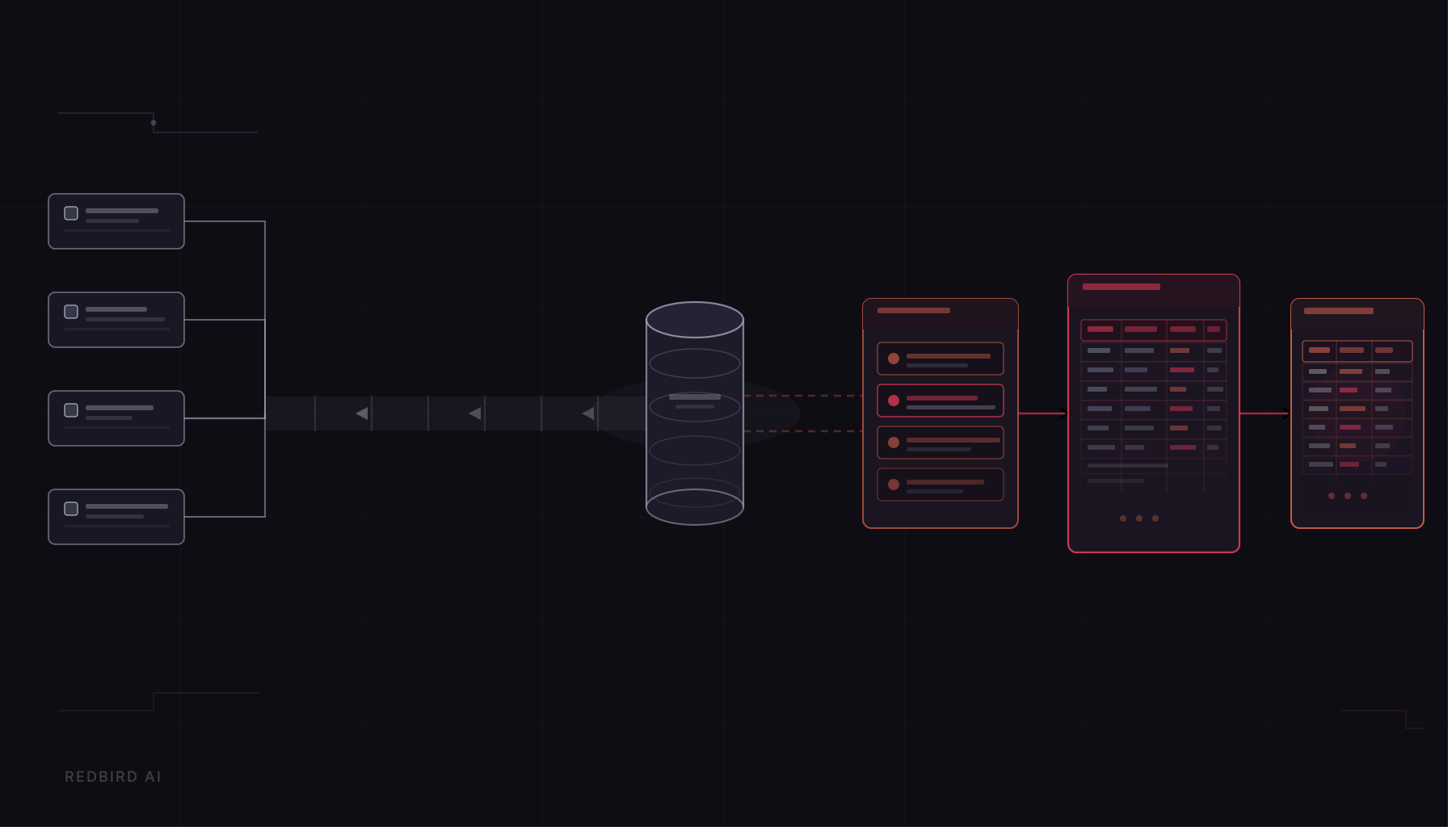
From there, Redbird's agents take over. Rather than relying on a single generative model to interpret and execute analytical tasks (which introduces accuracy and consistency problems at scale), Redbird uses a coordinated system of specialized agents. A Routing Agent decomposes the user's request and assigns it to the appropriate specialists. A Data Engineering Agent handles harmonization, joins, and transformation. An Analyst Agent applies business logic and computes metrics. A Reporting Agent assembles the output in the format the team actually uses, whether that is a formatted Excel file, a PowerPoint presentation built from an existing template, a Word document, or a live dashboard.
What this means in practice is that an analyst on a marketing team can request a weekly performance report across Google, Meta, and LinkedIn ad spend, and receive a formatted, validated output without writing SQL, reformatting spreadsheets, or manually updating slides. The workflow that used to take hours or days gets compressed into minutes, and the output is consistent because the business logic, metric definitions, and report templates have been codified into the platform.
How to Think About the Decision
The right framework for evaluating these tools depends on where your team's actual friction lives. If the core problem is reliable, low-cost data movement into a warehouse and you have a technical team to manage the rest of the stack, Airbyte or Stitch may be the right fit. If you have a mature data engineering function and want rigorous transformation governance, dbt belongs in the conversation. If you are heavily invested in Snowflake, Databricks, or BigQuery and want ingestion and transformation consolidated into one platform with serious depth, Matillion is worth a close look.
But if the problem is that your analytics and reporting team is spending the majority of its time on manual data preparation, reformatting, and output production rather than on the analysis and insights that drive decisions, you are dealing with a different problem than pipeline tooling can solve. The gap between "data is in the warehouse" and "stakeholder has a validated, formatted report" is where most of the analyst's week goes, and no ELT tool addresses it.
That is the case for a platform like Redbird. The goal is not to replace the warehouse or compete with the pipeline. It is to automate the workflow that sits on top of it, so that analysts spend their time on interpretation, judgment, and decision support rather than on the preparation work that precedes it. For analytics and reporting teams in particular, that is where the leverage is.
The modern data stack has gotten very good at moving and storing data. The harder problem, and the one that analytics and reporting teams feel every day, is making that data useful at the speed and quality the business actually needs, without requiring every output to be hand-assembled by an analyst stretched across too many tools. That is the problem worth solving in 2026, and it requires a different kind of tool than the ones that got us here.