Modern organizations do not lack data. They struggle with turning it into consistent, decision-ready outputs. Across business teams, analysts still spend the majority of their week pulling exports, reconciling spreadsheets, updating dashboards, and rebuilding executive presentations. Instead of driving strategy, teams are trapped in manual reporting cycles.
This is where data automation enters the conversation.
AI is rapidly transforming how data is collected, transformed, analyzed, and delivered. But the market is noisy. BI tools, ETL platforms, orchestration engines, AI assistants, and emerging agent-based systems all claim to automate analytics in some way. For executive leaders evaluating investments in reporting automation and analytics automation, understanding the architectural differences between these tools is critical.
This guide breaks down the modern data automation landscape, explains how today’s AI platforms are structured, and outlines what informed buyers should evaluate before making a decision.
What Is Data Automation?
Data automation refers to the use of software and AI systems to automate the full lifecycle of data work - from ingestion to executive-ready output.
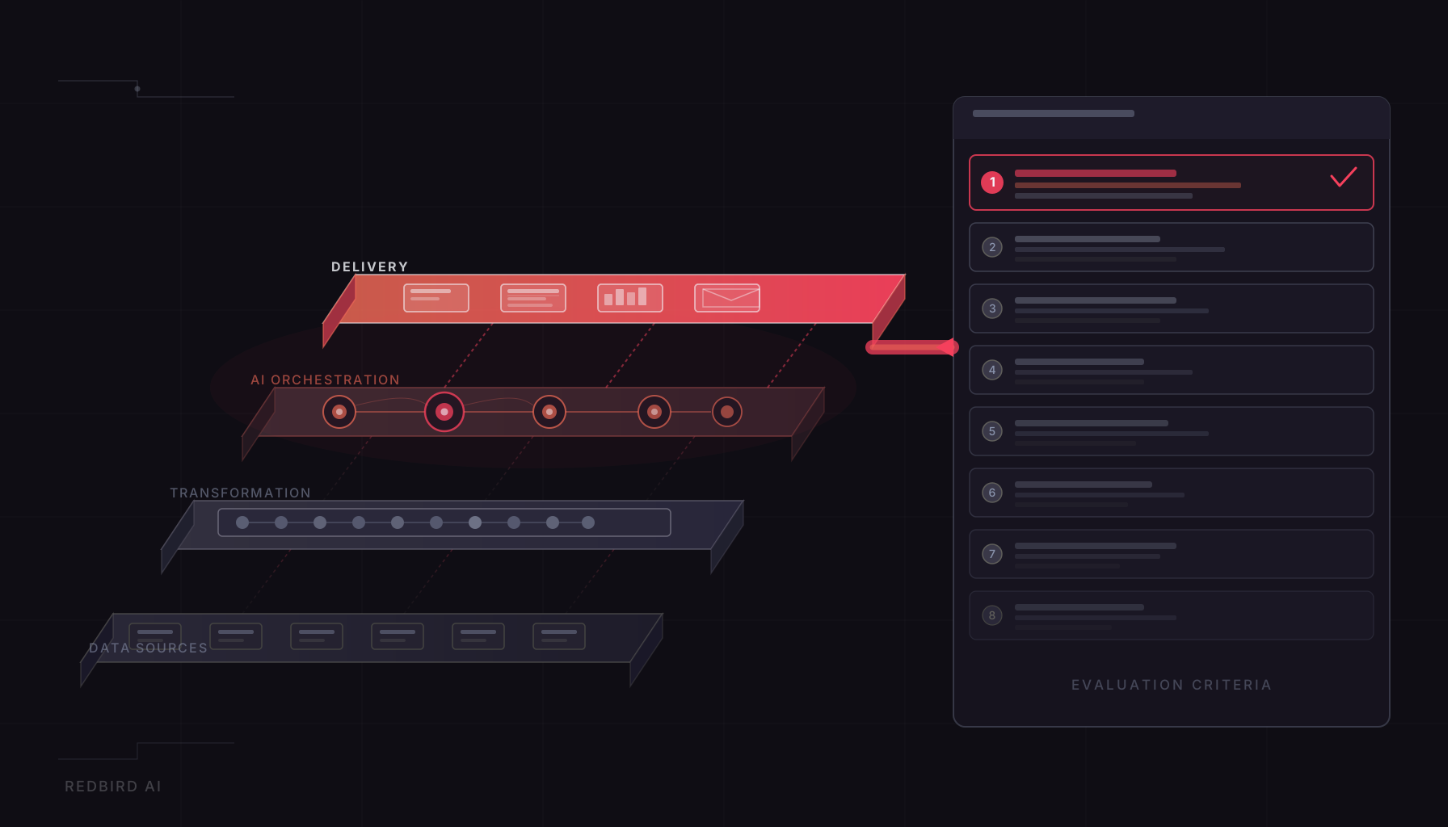
True data automation spans five core layers: connecting to source systems, transforming and harmonizing data, applying analytics and business logic, generating production-ready outputs, and optionally triggering downstream actions. Many tools automate one or two of these layers. Very few automate the entire workflow.
This distinction matters because partial automation often shifts work rather than eliminating it. A dashboard may automate visualization, but if analysts still manually prepare slides for executive meetings, reporting automation remains incomplete. A text-to-SQL assistant may generate queries, but if the data model is inconsistent or the output needs to be reformatted manually, analytics automation is only surface-level.
Full data automation means the workflow itself, not just the query, is automated.
The Evolution of Analytics Automation
To understand today’s landscape, it helps to see how enterprise analytics has evolved.
The first phase was entirely manual. Analysts exported CSV files, updated Excel spreadsheets, copied charts into PowerPoint, and validated numbers by hand. This approach worked when data volumes were smaller, but it does not scale in modern organizations.
The second phase introduced business intelligence platforms such as Tableau and Microsoft Power BI. Dashboards improved visibility and centralized metrics. However, they required structured data models, ongoing engineering support, and often failed to automate executive deliverables. Dashboards replaced some static reporting but did not eliminate the manual preparation of board-ready materials.
The third phase focused on pipeline automation. Tools like Fivetran and Airbyte streamlined data ingestion, while dbt standardized transformation logic inside the warehouse. Orchestration tools such as Apache Airflow scheduled workflows and managed dependencies. These systems significantly improved infrastructure efficiency, but they remained technical solutions. They automated pipelines, not executive workflows.
The fourth phase introduced AI assistants and text-to-SQL tools. Platforms like ChatGPT and Microsoft Copilot allowed users to query data in natural language. This was a major usability breakthrough. However, LLM-based tools alone typically operate with limited business context and probabilistic outputs. They may generate queries or summaries, but they do not reliably automate the full data lifecycle. Accuracy, governance, and reproducibility remain challenges when LLMs are used without deterministic orchestration.
We are now entering a fifth phase: agent-driven data automation platforms. These systems combine AI interpretation with structured orchestration, context management, and specialized agents that execute tasks across ingestion, transformation, analytics, and output generation. Rather than answering a question in isolation, they execute multi-step workflows autonomously. This marks the convergence of data automation, reporting automation, and analytics automation into a unified platform layer.
Categories of Data Automation Tools
Executives evaluating the market typically encounter several categories of tools, each solving a different part of the problem.
Business intelligence platforms remain strong in visualization and interactive exploration. They are effective when organizations already have well-managed data warehouses and analytics teams. However, they rarely eliminate manual reporting preparation.
ETL and ELT platforms specialize in reliable data ingestion. They connect to SaaS tools and move data into centralized warehouses. These systems are foundational but do not handle business logic, analytics, or executive deliverables.
Transformation tools standardize metrics and modeling logic. They improve governance and consistency but require SQL expertise and engineering ownership.
Workflow orchestration tools manage dependencies and scheduling. They are powerful infrastructure components but do not interpret business questions or produce executive-ready outputs.
AI assistants and text-to-SQL platforms improve accessibility. They reduce friction in querying data but often lack deep contextual awareness and deterministic control. Without additional architecture, they remain productivity enhancers rather than enterprise automation systems.
Agentic AI data platforms attempt to unify these layers. They combine connectivity, transformation, analytics, orchestration, and output generation into a single productivity layer that sits on top of the existing data ecosystem. Instead of replacing infrastructure, they accelerate it.
Understanding which category a vendor truly belongs to prevents costly misalignment between expectations and capabilities.
Architecture Patterns in Modern Data Automation Platforms
When evaluating platforms, marketing claims matter less than architectural design.
The first critical layer is data connectivity. Strong systems connect to warehouses, APIs, and enterprise systems, and can handle structured and semi-structured data reliably. Without robust ingestion, automation collapses at the first step.
The second layer is context management. This is where many AI-driven tools struggle. Enterprise analytics depends on defined metric logic, consistent calculations, reporting templates, and business rules. Platforms that ingest schema definitions, understand field mappings, and incorporate organizational logic produce significantly more reliable results. LLMs without structured context may generate plausible outputs that are subtly incorrect.
The third layer is orchestration. Enterprise workflows must be deterministic. While large language models are powerful at interpreting intent, they are probabilistic systems. Advanced data automation platforms use orchestration engines that decompose requests into structured tasks executed step-by-step by specialized agents. In well-designed architectures, LLMs interpret intent, but deterministic systems execute the work. This dramatically improves reliability and auditability.
The fourth layer is analytics and data science execution. Automation must support complex metric calculations, forecasting, anomaly detection, and domain-specific logic. Surface-level query generation is insufficient for enterprise use cases.
The fifth and often overlooked layer is output generation. For marketing and finance teams, the value of automation lies in receiving ready-to-use Excel files, PowerPoint presentations, dashboards, and documents - not just query results. True reporting automation ends when the deliverable is complete.
Together, these layers define whether a platform delivers partial automation or full data lifecycle automation.
Benefits of AI-Powered Data Automation
When implemented effectively, AI-powered data automation significantly changes how teams operate.
The most immediate impact is time recovery. Analysts regain hours previously spent reconciling data and rebuilding reports. This reclaimed capacity shifts focus toward strategic analysis and experimentation.
Decision velocity increases. Instead of waiting days for updated numbers, leaders can request analyses on demand. This is particularly powerful for marketing teams managing campaign performance and finance teams tracking forecast variance.
Consistency improves across departments. When business logic is centralized and automated, disputes over metric definitions decrease. This strengthens organizational alignment.
Finally, organizations achieve greater return on existing data infrastructure investments. Warehouses, BI tools, and data science models become more valuable when integrated into automated workflows.
Risks and Considerations
Despite the promise of analytics automation, executives should evaluate risks carefully.
Over-reliance on LLM-only solutions introduces hallucination and accuracy concerns. Systems must incorporate governance, audit trails, and deterministic logic.
Tool fragmentation increases maintenance overhead. Stitching together ingestion, transformation, AI querying, and reporting tools may recreate the very complexity automation is meant to eliminate.
Building internally can be expensive and time-consuming. Developing a custom agent-based automation platform requires AI expertise, infrastructure design, and continuous tuning. For many organizations, the opportunity cost outweighs the benefit.
An informed buyer evaluates not just feature lists, but architectural depth and long-term sustainability.
The Future of Data Automation
The enterprise analytics landscape is shifting from dashboards and ad hoc queries toward autonomous workflows.
Dashboards improved visibility.
Text-to-SQL improved accessibility.
AI copilots improved productivity.
The next stage improves execution.
Modern data automation platforms aim to function as a productivity layer on top of the existing ecosystem. They do not require organizations to rip and replace infrastructure. Instead, they unify ingestion, analytics, orchestration, and reporting into a coherent system that reduces manual work at scale.
For business leaders, the strategic opportunity is not simply adopting AI. It is redesigning how analytical work flows through the organization.
As the market matures, the distinction between surface-level AI tools and full-stack data automation platforms will become clearer. Architecture - not interface - will determine outcomes.
Organizations that understand this shift will move faster, operate more efficiently, and turn analytics from a reporting function into a competitive advantage.